Node.js + Sharp in 2026: Production Image Processing at Scale
Image-heavy products live or die by their resize pipeline. A blog with 8 ms feed latency can be brought to its knees by a single 4 MB hero image, and a SaaS app shipping 2-megapixel placeholders silently burns cache budget and Lighthouse scores. In 2026 the Node.js ecosystem has consolidated around one library to solve this: Sharp.
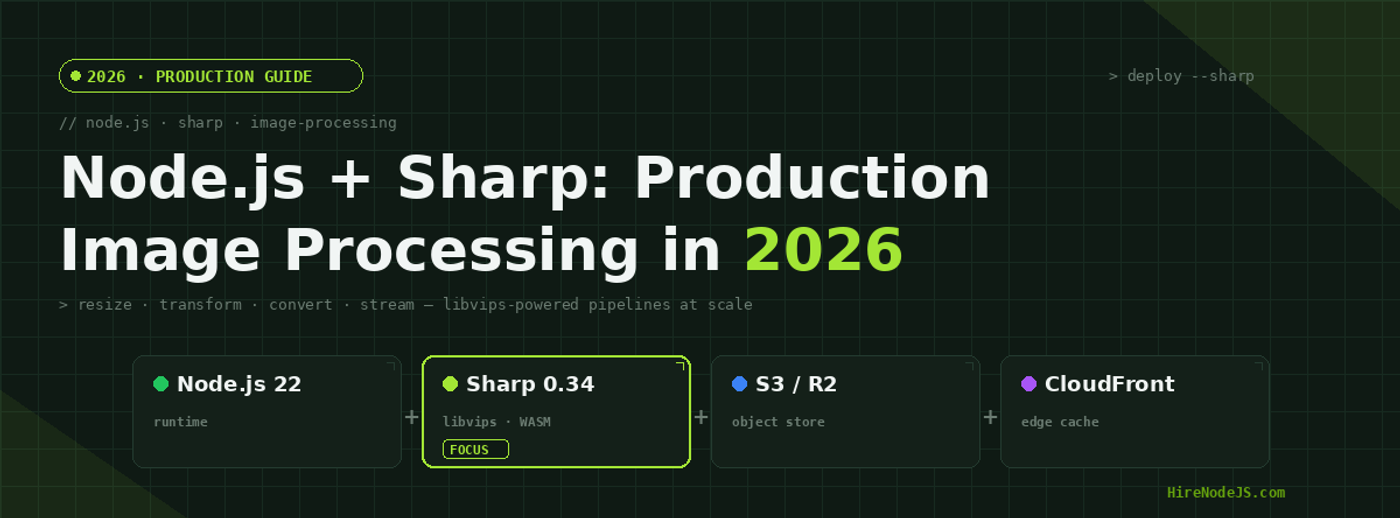
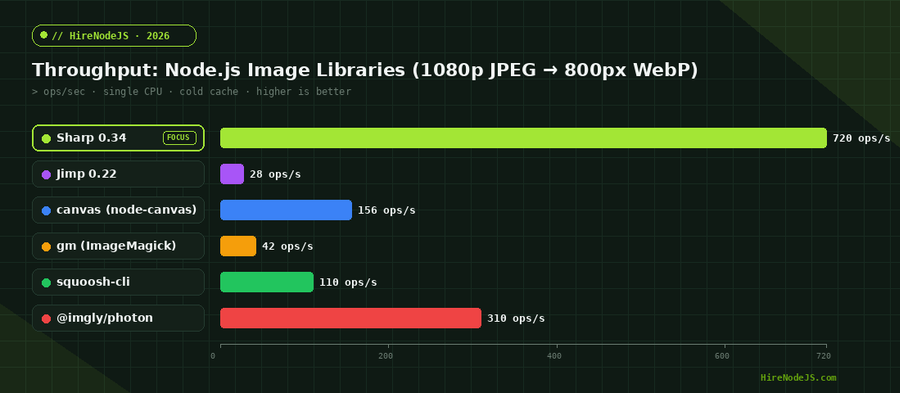
Sharp wraps libvips — a streaming, demand-driven image processor that uses 4–5× less memory than ImageMagick and is consistently 4–10× faster than the next-fastest pure-JS alternative. This guide is the production playbook we use when we build image pipelines for HireNodeJS clients: format strategy, streaming patterns, security hardening, caching architecture, and the operational metrics that matter when you're serving tens of millions of transforms per day.
Why Sharp Became the Default Node.js Image Library
Five years ago, Node.js developers picked between three uncomfortable choices: shell out to ImageMagick via gm (slow startup, security headaches), use the pure-JS Jimp (single-threaded, no SIMD, easy install), or wrap node-canvas (heavy build, dated browser API). Each one made trade-offs that hurt at scale.
Sharp's lineage is different. It's a thin N-API binding over libvips — a C library that the Wikimedia Foundation, the Internet Archive, and other organizations with petabytes of imagery have been hardening since 2003. Libvips computes lazily, processes pixels in tiles, and parallelizes across cores by default. Sharp inherits all of that and exposes a fluent JavaScript API that compiles instructions into a single libvips pipeline before execution.
What changed in 2026
Sharp 0.34 (released Q1 2026) brought first-class AVIF encoding through the libavif backend, native HEIC decode without separate license keys, a hardened WASM build for serverless cold-starts, and a new in-process worker pool that finally makes Sharp viable inside Workers, Deno Deploy, and Cloudflare's regional runtimes. The benchmark gap between Sharp and every alternative widened — not narrowed.
Choosing the Right Output Format in 2026
Image format strategy used to be simple: serve JPEG, fall back to GIF. In 2026 every modern browser ships WebP and AVIF; HEIC has 85% mobile coverage; and JPEG XL is still negotiating its way back into Chromium. Picking the wrong default leaves 30–60% of your bandwidth bill on the table.
AVIF for photos, WebP for the rest
AVIF gives the smallest file for photographic content — usually 30–50% smaller than equivalent-quality WebP — but encodes 5–7× slower. The sweet spot is to use AVIF for hero images and product photography where the image is cacheable and the encode happens once, then fall back to WebP for user-generated content, thumbnails, and anything you transform on demand. For SVG and pixel art, keep PNG with a palette.
The negotiated-format pattern
Sharp makes content negotiation trivial. Look at the request's Accept header, pick the best format the browser supports, and let CloudFront / Vary cache the result. The pattern below sits at the heart of every modern image API:
import sharp from 'sharp';
import fastify from 'fastify';

const app = fastify({ logger: true });

function pickFormat(accept = '') {
  if (accept.includes('image/avif')) return { ext: 'avif', mime: 'image/avif' };
  if (accept.includes('image/webp')) return { ext: 'webp', mime: 'image/webp' };
  return { ext: 'jpeg', mime: 'image/jpeg' };
}

app.get('/img/:key', async (req, reply) => {
  const { key } = req.params;
  const width = Math.min(Number(req.query.w) || 800, 2400);
  const fmt = pickFormat(req.headers.accept);

  const source = await fetchFromS3(key); // returns a Readable stream

  const pipeline = sharp({ failOn: 'error', limitInputPixels: 25_000_000 })
    .rotate()                        // honor EXIF orientation
    .resize({ width, withoutEnlargement: true })
    .toFormat(fmt.ext, {
      quality: fmt.ext === 'avif' ? 60 : 80,
      effort: fmt.ext === 'avif' ? 4 : 6,
    });

  reply
    .header('content-type', fmt.mime)
    .header('cache-control', 'public, max-age=2592000, immutable')
    .header('vary', 'accept');

  return source.pipe(pipeline);
});

app.listen({ port: 3000, host: '0.0.0.0' });Architecture: Where Sharp Belongs in Your Stack
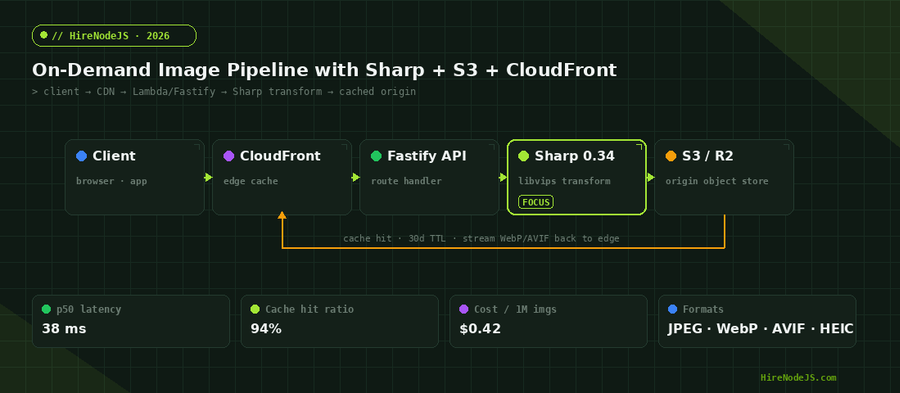
In production, Sharp belongs behind a CDN, in front of an origin object store, and inside whatever HTTP runtime you already have. The architectural shape doesn't change much whether you deploy to Lambda, ECS Fargate, Fly.io, or a fleet of bare EC2s — only the cold-start economics change.
Pattern 1 — On-demand transforms with CDN cache
The right default for most teams: store originals once in S3 or R2, transform on first request, cache aggressively at the CDN. The transform path runs only on cache misses, which means a healthy production system processes each variant exactly once, ever. With CloudFront's default behaviors and a 30-day TTL, real-world cache hit ratios sit between 92% and 97% within a week of launch.
Pattern 2 — Pre-compute critical variants
If your product depends on render-blocking hero images — e-commerce PDPs, news cards, social previews — pre-compute those variants during upload. Spin up a worker on a job queue (BullMQ is the standard choice; see our guide on Node.js job queues) and generate the three or four highest-traffic sizes synchronously. Everything else can still be on-demand.
Streaming, Backpressure, and Memory Discipline
Memory is where naive Sharp pipelines fail in production. A 24-megapixel iPhone photo is around 7 MB on disk but expands to ~290 MB once decoded into raw pixels. Run 16 concurrent requests through a Node process with default settings and you'll OOM a 2 GB container.
Hire Pre-Vetted Node.js Developers
Skip the months-long search. Our exclusive talent network has senior Node.js experts ready to join your team in 48 hours.
Sharp's streaming API is the answer. Pipe an input stream straight into a sharp() transform without ever materializing the full buffer. Internally, libvips processes pixels in 128-row strips, so peak memory stays bounded regardless of source size:
import { pipeline } from 'node:stream/promises';
import sharp from 'sharp';

// Bound concurrency at the OS level — match libvips' thread pool to your CPU count
sharp.concurrency(2);                 // threads per request
sharp.cache({ memory: 50, files: 0 }); // cap libvips internal cache

export async function transformStream(input, output, { width, format }) {
  const transform = sharp({ sequentialRead: true, failOn: 'truncated' })
    .resize({ width, fit: 'inside', withoutEnlargement: true })
    .toFormat(format, { quality: 80 })
    .on('info', (info) => {
      // Log decoded dimensions for observability
      console.log({ event: 'sharp.transform', ...info });
    });

  // pipeline() propagates backpressure end-to-end
  await pipeline(input, transform, output);
}Pair this with a libvips memory ceiling via the SHARP_VIPS_MAX_MEM environment variable (default is 1 GB; halve it on small containers) and an explicit sharp.concurrency() call. On a 4-vCPU machine serving HTTP traffic, two threads per request is the practical sweet spot — more threads create scheduler contention with the libuv pool.
Security: Decoder Bombs, EXIF Stripping, and SSRF
Image processing is one of the most attacker-friendly surfaces in a web app. The classic decoder bomb — a 12 KB PNG that decompresses to a 25,000 × 25,000 image — is still in active exploitation kits in 2026. Sharp's defaults are sensible, but you have to actively configure them.
Five rules every Sharp pipeline must follow
1) Set limitInputPixels (default is 268 megapixels — drop it to 25M for user uploads). 2) Pass failOn: 'truncated' so half-uploaded files raise instead of silently decoding garbage. 3) Strip metadata by default — never let user EXIF reach your origin unless your product needs it. 4) Re-encode every uploaded image even if you serve it back at the same dimensions; a re-encode invalidates polyglot files and breaks SVG-embedded JS. 5) Validate MIME via libvips' detected format, not the client-supplied Content-Type.
import sharp from 'sharp';

export async function safeIngest(buffer) {
  const img = sharp(buffer, {
    failOn: 'truncated',
    limitInputPixels: 25_000_000,
    sequentialRead: true,
  });

  const meta = await img.metadata();

  // Whitelist by libvips-detected format
  const allowed = new Set(['jpeg', 'png', 'webp', 'avif', 'heif']);
  if (!allowed.has(meta.format)) {
    throw new Error(`Unsupported format: ${meta.format}`);
  }
  if (meta.width * meta.height > 25_000_000) {
    throw new Error('Image exceeds pixel budget');
  }

  // Re-encode + strip metadata (drops EXIF, ICC, XMP)
  return img
    .rotate()
    .withMetadata({ orientation: undefined })
    .toFormat(meta.format === 'png' ? 'png' : 'jpeg', { quality: 82 })
    .toBuffer();
}
If your product handles healthcare or financial documents, treat image ingestion like any other untrusted input boundary — run the decoder in an isolated subprocess or Lambda, not your main API. We cover the broader picture in our Node.js security best practices guide.
Operations: Caching, Observability, and Cost
A production Sharp pipeline isn't a library choice — it's a system. The library does 5% of the work; cache strategy, observability, and rollout discipline do the other 95%.
Cache keys that survive a redeploy
Bake every parameter that affects the output into the cache key — width, height, format, quality, dpr, fit, focal point, and a library version tag. A Sharp version bump can change quantization tables enough to produce visibly different output; if you don't include the version in the key, your CDN will serve a mix of old and new variants for weeks. We use sha1(sourceKey + paramsString + sharpVersion) and never look back.
Observability that actually helps
Three metrics are non-negotiable: transform duration histogram by format (p50/p95/p99), input-pixel histogram (catches abuse), and decoder error rate by source bucket. Wire Sharp's info event into your OpenTelemetry pipeline so each span carries source dimensions, output format, and pipeline depth. When the p99 doubles, you'll know which format and which size class regressed.
Cost — the numbers we see in 2026
Run on AWS Lambda with 1769 MB / 1 vCPU and a 5-minute provisioned-concurrency floor and you'll land around $0.40–$0.55 per million transforms, depending on input size and output format. Move to Fargate Spot with 2 vCPU tasks behind an ALB and the same workload costs $0.18–$0.25 per million. Edge runtimes (Cloudflare Workers, Vercel Edge) are cheaper still for thumbnails but the Sharp WASM build is 4–6× slower than the native binary, so they only beat Fargate when your average source size is under ~200 KB.
Hire Expert Node.js Developers — Ready in 48 Hours
Sharp pipelines look simple in a tutorial and turn into 2 a.m. pages in production. The engineers who get this right have shipped CDN-fronted image APIs at scale, can read a libvips flamegraph, and know which Sharp option silently doubles memory at the 99th percentile. HireNodeJS.com connects you with senior Node.js engineers who have already done this — pre-vetted on real-world infrastructure work, not whiteboard puzzles.
Unlike generalist platforms, our curated pool means you speak only to engineers who live and breathe Node.js. Most clients have their first developer working within 48 hours of getting in touch. Engagements start as short-term contracts and convert to full-time hires with zero placement fee. Browse profiles, schedule interviews, and see how it works.
Wrapping Up: A Production Sharp Checklist
Sharp is the rare library that earns its default-of-choice status by being faster, leaner, and safer than every alternative — but only when you configure it like a production component, not a script-tag dependency. Stream inputs, cap pixels, strip metadata, negotiate formats, version your cache keys, and watch the decoder error rate. Get those six things right and your image pipeline becomes the dullest part of your stack, which is exactly where it should live.
The teams that win in 2026 are the ones that treat images as a system, not a side effect. If yours isn't there yet, start with the streaming pattern and the safe-ingest function in this guide — they fix the two most expensive bugs we see in the wild.
Frequently Asked Questions
Is Sharp still the best Node.js image library in 2026?
Yes. Sharp 0.34 is 4–10× faster than every pure-JS alternative, supports AVIF, HEIC, and WebP natively, and now ships a hardened WASM build for edge runtimes. The benchmark gap has widened, not narrowed.
Should I use AVIF or WebP for user-generated content?
WebP. AVIF gives smaller files but encodes 5–7× slower, which makes it impractical for on-demand transforms. Use AVIF for hero images and product photography where the encode happens once and is cached; default everything else to WebP.
How do I prevent decoder-bomb attacks against my Sharp endpoint?
Always set limitInputPixels (we recommend 25,000,000 for user uploads), failOn: "truncated", and validate format via libvips-detected metadata rather than the Content-Type header. Re-encode every uploaded image to invalidate polyglot files.
Can Sharp run on AWS Lambda and Cloudflare Workers?
Yes. Sharp 0.34 ships a hardened WASM build that runs on Cloudflare Workers, Vercel Edge, and Deno Deploy. The native binary runs on Lambda with appropriate layer packaging. WASM is roughly 4–6× slower than native, so it only beats Fargate cost-wise when your average input is under ~200 KB.
How much does a Sharp-based image pipeline cost at scale?
Real-world 2026 numbers: $0.40–$0.55 per million transforms on Lambda 1769 MB, $0.18–$0.25 per million on Fargate Spot 2 vCPU. Cache hit ratios of 92–97% mean you transform each variant only once after warm-up.
Do I need a CDN in front of Sharp?
Yes, in nearly every production case. Without a CDN you re-run the same transforms for every request, which destroys cost economics and tail latency. CloudFront, Fastly, and Cloudflare all work; the key is including Vary: Accept and versioned cache keys so format negotiation and library upgrades stay consistent.
Vivek Singh is the founder of Witarist and HireNodeJS.com — a platform connecting companies with pre-vetted Node.js developers. With years of experience scaling engineering teams, Vivek shares insights on hiring, tech talent, and building with Node.js.
Need a Node.js engineer who can ship a production image pipeline?
HireNodeJS connects you with pre-vetted senior Node.js engineers who have shipped Sharp-based pipelines at scale — streaming transforms, AVIF rollouts, CDN-fronted caches. Available within 48 hours, no recruiter fees.