Node.js + Stripe in 2026: The Production Payments Guide
Stripe has quietly become the default payments rail for modern Node.js applications. In 2026, almost every SaaS, marketplace, and consumer app you ship will need at least one of: card capture, recurring subscriptions, marketplace payouts, or webhook-driven order fulfilment. The Node SDK is mature, the docs are excellent, and the surface area you actually have to integrate is surprisingly small — yet teams still get production payments wrong in expensive, traceable ways.
This guide is the playbook we use when we hire Node.js developers for payments-heavy product teams. It walks through Stripe's modern PaymentIntents flow, secure webhook handling, idempotency, subscriptions, refunds, dispute defense, and the operational habits that keep your accounting team sane. Code is real, the architecture is battle-tested, and every recommendation here ships in production today.
Why PaymentIntents Replaced the Charges API
The legacy Charges API still works, but every new integration in 2026 should use PaymentIntents. PaymentIntents wrap the entire payment lifecycle — authorization, 3D Secure challenges, off-session retries, and capture — into a single object you persist in your database. Your Node API never has to track auth state across multiple Stripe calls; the PaymentIntent does it for you.
Three reasons PaymentIntents win
First, PaymentIntents handle Strong Customer Authentication (SCA) automatically — required across the EU, UK, and increasingly mandatory for high-value US transactions in 2026. Second, the status machine (requires_payment_method → requires_confirmation → requires_action → succeeded) is explicit and easy to reason about. Third, you can reuse the same intent across multiple confirmation attempts without double-charging the customer.
The minimum viable Node integration
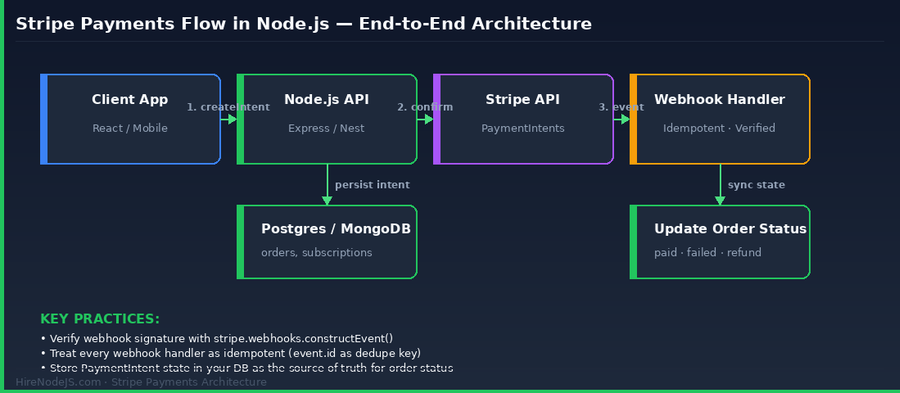
You need three endpoints: one to create a PaymentIntent and return its client_secret, one to handle the webhook that confirms the charge succeeded, and a small admin route to issue refunds. Everything else — receipts, dunning, chargeback evidence — Stripe will run for you if you let it.
Setting Up the Stripe SDK in Node.js
Install the official SDK and pin the API version. The SDK pairs perfectly with TypeScript — Stripe ships first-class types and a strict apiVersion typing that prevents silent breaking-change bugs when Stripe rolls out new features.
import Stripe from 'stripe';

// Pin the API version. Never use 'latest' in production —
// Stripe rolls webhooks-shape changes with the API version.
export const stripe = new Stripe(process.env.STRIPE_SECRET_KEY!, {
  apiVersion: '2025-09-30.acacia',
  typescript: true,
  maxNetworkRetries: 2,         // retry idempotent requests
  timeout: 20_000,              // 20s — fail fast if Stripe is slow
  telemetry: false,             // disable client telemetry in EU prod
});

// Create a PaymentIntent — called from your /create-checkout endpoint
export async function createPaymentIntent(amountCents: number, customerId: string, orderId: string) {
  return stripe.paymentIntents.create({
    amount: amountCents,
    currency: 'usd',
    customer: customerId,
    automatic_payment_methods: { enabled: true },
    metadata: { orderId },           // reconcile back to your DB
  }, {
    idempotencyKey: `order_${orderId}_intent`,  // safe to retry
  });
}Environment variables you must rotate
STRIPE_SECRET_KEY (server only, never bundled), STRIPE_WEBHOOK_SECRET (one per endpoint, rotated quarterly), and STRIPE_PUBLISHABLE_KEY (safe to send to the browser). Use a secrets manager — AWS Secrets Manager, Doppler, or 1Password — never check these into git, and never log them.
Handling Stripe Webhooks the Right Way
Webhooks are where most Stripe integrations fail. The two failure modes that cost teams real money are: (1) accepting unsigned events from anyone who knows your URL, and (2) processing the same event twice when Stripe retries. Solve both at the framework level — never trust application code to remember the rules.
Verify the signature on every event
import express from 'express';
import { stripe } from './stripe.js';
import { db } from './db.js';

export const router = express.Router();

// IMPORTANT: this route MUST receive the raw body, not JSON-parsed.
// In your app.ts: app.use('/webhooks', express.raw({ type: 'application/json' }))
router.post('/stripe', async (req, res) => {
  const sig = req.headers['stripe-signature'] as string;
  let event;

  try {
    event = stripe.webhooks.constructEvent(
      req.body,                              // raw Buffer
      sig,
      process.env.STRIPE_WEBHOOK_SECRET!,
    );
  } catch (err) {
    // Signature failure — log and return 400. Never tell the attacker why.
    console.error('webhook signature verify failed', { err: (err as Error).message });
    return res.status(400).send('invalid signature');
  }

  // Idempotency: dedupe by event.id. Insert returns false if already seen.
  const fresh = await db.processed_events.insertIfMissing(event.id, event.type);
  if (!fresh) {
    return res.status(200).send('already processed');
  }

  try {
    switch (event.type) {
      case 'payment_intent.succeeded':
        await handleIntentSucceeded(event.data.object);
        break;
      case 'payment_intent.payment_failed':
        await handleIntentFailed(event.data.object);
        break;
      case 'invoice.paid':
        await handleSubscriptionRenewal(event.data.object);
        break;
      case 'charge.dispute.created':
        await handleDisputeOpened(event.data.object);
        break;
      // ... add the rest of your subscribed events
    }
    res.status(200).send('ok');
  } catch (err) {
    // Roll back the dedupe row so Stripe retries this event.
    await db.processed_events.delete(event.id);
    console.error('handler failed', { eventId: event.id, err });
    res.status(500).send('handler error');
  }
});
Subscriptions, Billing, and Smart Dunning
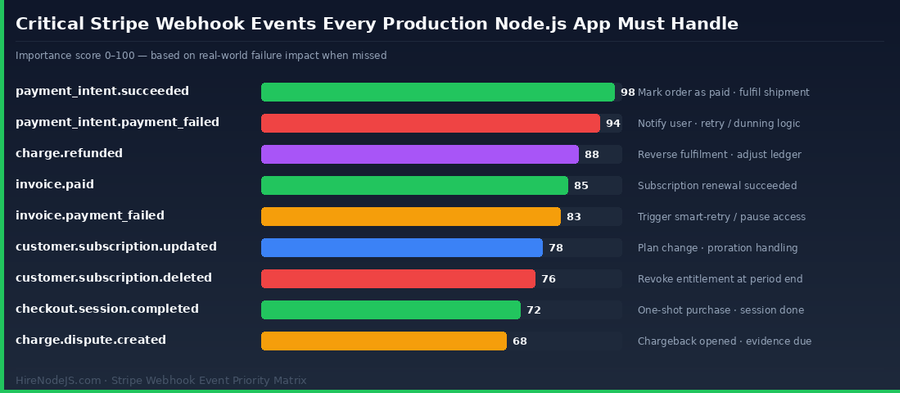
Subscriptions are where Stripe pays for itself. Billing, proration on plan changes, smart retries ("dunning") for failed renewals, and tax calculation are all handled inside Stripe Billing. Your Node API only needs to react to four events: invoice.paid, invoice.payment_failed, customer.subscription.updated, and customer.subscription.deleted. Building a backend service that reacts to these correctly is a 2-day project — not a 2-month one.
Hire Pre-Vetted Node.js Developers
Skip the months-long search. Our exclusive talent network has senior Node.js experts ready to join your team in 48 hours.
The four events that drive entitlement
On invoice.paid, extend the customer's access to the next period. On invoice.payment_failed, mark the subscription as past_due and trigger your grace-period flow. On customer.subscription.updated, sync plan, quantity, and trial_end. On customer.subscription.deleted, revoke entitlement at the period end — never immediately, or you'll trigger a chargeback storm.
Smart Retries vs custom dunning
Stripe's Smart Retries use ML to pick the optimal retry window per failure code; in our experience they recover 30–45% of involuntary churn with zero engineering effort. If you need custom dunning logic — a personalized email at attempt 1, an in-app banner at attempt 3 — drive it from the invoice.payment_failed event with attempt_count, not from a cron job.
Idempotency, Retries, and the 99.99% Reliability Bar
Payments are the one part of your stack where a duplicate write can directly cost a customer money. Idempotency is not optional — it's the contract. Stripe's idempotency model is simple, but you have to use it everywhere a retry could possibly happen, including HTTP timeouts, network blips, and your own job queues.
The three layers of idempotency
Layer 1: every Stripe write call carries a deterministic Idempotency-Key header tied to a domain identifier. Layer 2: every webhook handler dedupes on event.id at the database layer with a unique constraint. Layer 3: every job in your background queue (BullMQ, RabbitMQ) carries a job ID derived from the order or invoice it's processing — never a UUID generated at enqueue time.
What to monitor
Track these four metrics in production: webhook signature failures, handler latency p95, idempotency-key collisions, and Stripe API error rate. Push them to your observability stack — Datadog, Grafana, or New Relic — and alert on any spike beyond two standard deviations.
Refunds, Disputes, and Staying Out of PCI Scope
Refunds are simple — a single stripe.refunds.create() call with the charge ID and an idempotency key. Disputes (chargebacks) are not. A dispute opens a 7- to 21-day evidence window during which Stripe pulls funds out of your account. Your Node API needs an automated evidence-submission flow: order, shipping confirmation, customer communication, and product description, packaged into stripe.disputes.update().
Stay out of PCI-DSS scope
Never let a raw card number touch your servers. Use Stripe Elements or Checkout on the front end so card data is tokenized in the browser and your backend only ever sees opaque payment_method IDs. This drops your PCI scope from full SAQ-D to SAQ-A — the difference between a $30k/year audit and a 12-question self-assessment.
Hire Expert Node.js Developers — Ready in 48 Hours
Building a payments backend is only half the battle — you need engineers who have lived through real Stripe production incidents to do it safely. HireNodeJS.com specialises exclusively in Node.js talent: every developer is pre-vetted on real-world projects, API design, webhook reliability, and PCI-aware architecture.
Unlike generalist platforms, our curated pool means you speak only to engineers who live and breathe Node.js. Most clients have their first developer working within 48 hours of getting in touch. Engagements start as short-term contracts and can convert to full-time hires with zero placement fee.
Final Takeaways for Production Stripe in 2026
Stripe in Node.js is not a hard integration — but it's a high-stakes one. The teams that ship reliable payments do four things consistently: pin the API version, sign every webhook, dedupe every event, and use deterministic idempotency keys end-to-end. Add an automated dispute-evidence flow on top, keep card data out of your servers, and you'll spend more time growing revenue than firefighting payment incidents.
The patterns above scale from a 10-customer beta to a Series-C company processing eight figures a month. Get the foundation right early — refactoring payments code while live customers are charging is the single most painful experience in backend engineering.
Frequently Asked Questions
Is Stripe a good choice for Node.js applications in 2026?
Yes — Stripe has the most mature Node.js SDK of any payment provider, with first-class TypeScript types, automatic API version pinning, and excellent retry semantics. It is the default choice for new SaaS, marketplace, and consumer Node.js apps.
How do I make Stripe webhooks idempotent in Node.js?
Insert the event.id into a database table with a unique constraint before processing. If the insert fails, you have already processed the event — return 200. If the handler throws, delete the row so Stripe retries.
What is the difference between PaymentIntents and the legacy Charges API?
PaymentIntents wrap the entire payment lifecycle — auth, 3D Secure, off-session retries, capture — into a single object you persist. Charges only model a one-shot card sale. PaymentIntents are required for SCA compliance in 2026.
How much does Stripe cost in 2026?
Stripe charges 2.9% + 30¢ for US card transactions, 1.5% + 20p for UK cards, and 0.8% + 25¢ for SEPA. Subscriptions and Billing add no incremental percentage. Volume discounts kick in around $80k/month in processed volume.
Can a Node.js Stripe integration stay out of PCI-DSS scope?
Yes — use Stripe Elements or Checkout on the front end so card data is tokenized in the browser. Your backend only ever sees opaque payment_method IDs, dropping you from PCI SAQ-D to SAQ-A.
How long does it take to hire a Node.js developer who can ship Stripe in production?
On HireNodeJS, most clients have a vetted Stripe-experienced Node.js engineer working on their codebase within 48 hours. The platform pre-screens for real production payment experience, not just SDK familiarity.
Vivek Singh is the founder of Witarist and HireNodeJS.com — a platform connecting companies with pre-vetted Node.js developers. With years of experience scaling engineering teams, Vivek shares insights on hiring, tech talent, and building with Node.js.
Need a Node.js Engineer Who Has Shipped Stripe to Production?
HireNodeJS connects you with pre-vetted senior Node.js engineers experienced with Stripe, webhooks, subscriptions, and PCI-aware architecture — available within 48 hours, no recruiter fees.