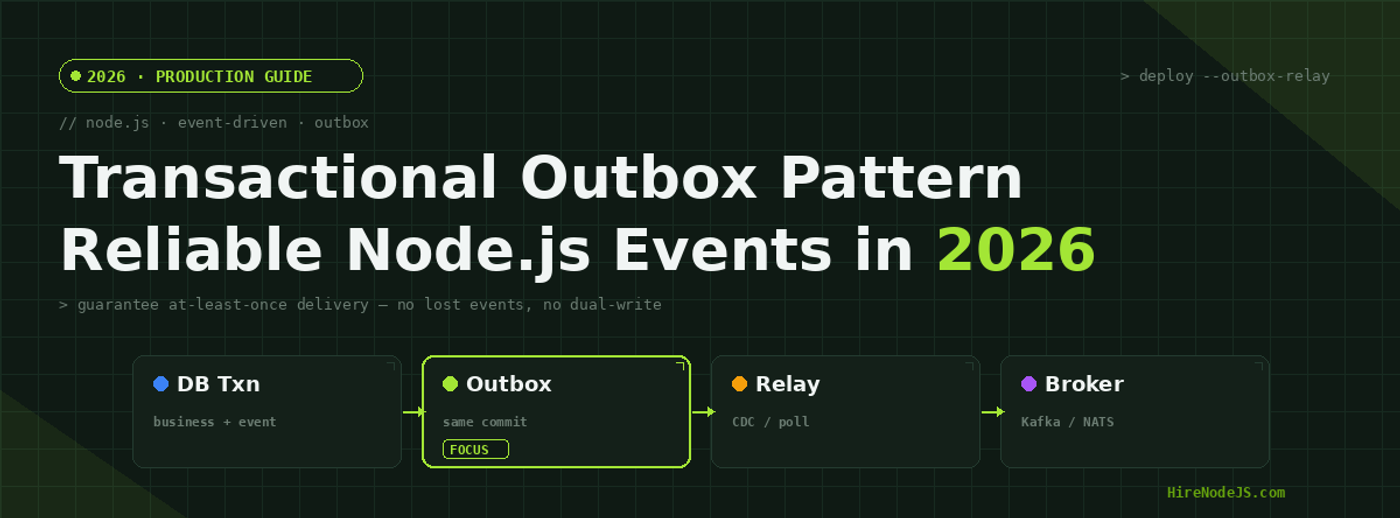
Node.js Transactional Outbox Pattern: Reliable Events 2026
Every backend that does two things at once eventually hits the same wall: it writes a row to the database and then publishes an event to a message broker. Those are two separate systems, and there is no transaction that spans both. When the process crashes in the gap between them — and over millions of requests, it will — you are left with a committed order that no downstream service ever heard about, or an event for a payment that was rolled back. This is the dual-write problem, and in 2026 it remains one of the most common sources of silent data corruption in distributed Node.js systems.
The transactional outbox pattern fixes this by refusing to write to two systems at once. Instead, the event is stored in an outbox table inside the very same database transaction as your business data, and a separate relay process publishes it afterwards. It is a deceptively simple idea with deep consequences for reliability — and it is exactly the kind of architecture decision that separates senior engineers from the rest. If you are building event-driven services and need people who have shipped this in production, you can hire backend developers who have already lived through the failure modes below.
The Dual-Write Problem: Why Events Get Lost
Picture the simplest possible flow. A request comes in, you insert an order into PostgreSQL, and then you call broker.publish() to tell the rest of the system. In the happy path this works fine. The trouble is that a database commit and a network publish are independent operations with no shared atomicity. Four distinct failure orderings are possible, and two of them lose data.
Commit succeeds, publish fails
The order is durably saved, but the process dies — a deploy, an OOM kill, a transient broker outage — before the event is published. Downstream services never learn the order exists. Inventory is not reserved, the confirmation email never sends, analytics undercounts revenue. Nobody throws an error; the data is simply inconsistent forever.
Publish succeeds, commit fails
The inverse is just as bad. You publish first, then the transaction rolls back due to a constraint violation or a deadlock. Now consumers act on an order that does not exist. They charge a card, ship a product, or trigger a fraud check against a phantom record. Retries and compensations pile up to clean this mess — work that the outbox pattern eliminates by construction.
The retry trap
Teams often try to paper over this with retry loops or a try/catch that republishes on failure. But a retry that runs after a crash never runs at all, and a retry inside the request handler still cannot make two systems atomic. You cannot solve a distributed-atomicity problem with more application code in one of the two systems. You need a single source of truth — and you already have one: the database.
How the Transactional Outbox Works
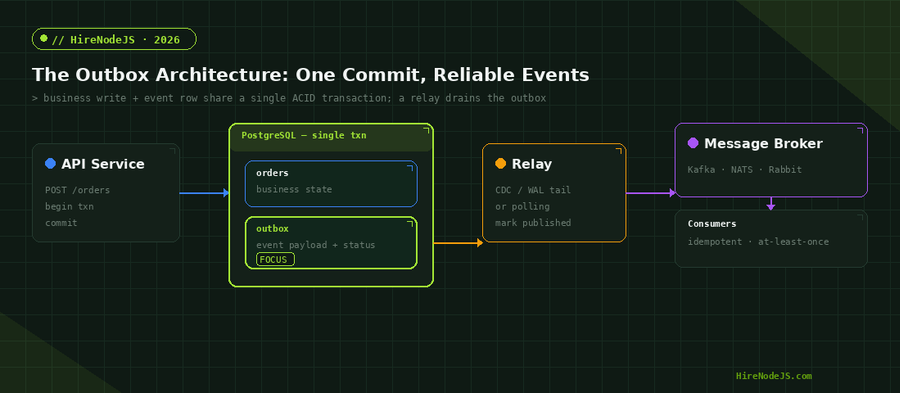
The pattern has three moving parts: the outbox table, the atomic write, and the relay. Together they convert an unreliable dual-write into a reliable single-write plus an asynchronous, retryable publish.
One transaction, two inserts
Inside a single database transaction you insert the business row and a corresponding row into the outbox table. Because both inserts share one commit, they are atomic: either both land or neither does. If the process crashes a microsecond later, the event is already durably recorded next to the data that produced it. There is no window in which the order exists but the event does not.
The relay drains the outbox
A separate process — the message relay — reads unpublished rows from the outbox and publishes them to the broker, marking each as sent once the broker acknowledges. If the relay crashes mid-batch, it simply resumes from the unpublished rows on restart. The worst case is that an event is published twice, which is why consumers must be idempotent. This trade is deliberate: the outbox guarantees at-least-once delivery, never exactly-once, and that is the correct guarantee for almost every real system.
Building the Outbox in Node.js
A production outbox in Node.js needs surprisingly little code. The example below uses the node-postgres driver against PostgreSQL — a database whose strong transactional guarantees make it the natural home for this pattern, and a skill set you can hire PostgreSQL specialists for when the schema gets serious. The key is that both inserts run on the same client inside BEGIN/COMMIT.
import { Pool } from 'pg';

const pool = new Pool({ connectionString: process.env.DATABASE_URL });

// Atomically persist the business row AND the event it produces.
export async function createOrder(order) {
  const client = await pool.connect();
  try {
    await client.query('BEGIN');

    const { rows } = await client.query(
      `INSERT INTO orders (customer_id, total_cents, status)
       VALUES ($1, $2, 'confirmed') RETURNING id`,
      [order.customerId, order.totalCents]
    );
    const orderId = rows[0].id;

    // Same transaction -> the event can never be lost.
    await client.query(
      `INSERT INTO outbox (aggregate_type, aggregate_id, event_type, payload)
       VALUES ('order', $1, 'order.confirmed', $2)`,
      [orderId, JSON.stringify({ orderId, ...order })]
    );

    await client.query('COMMIT');
    return orderId;
  } catch (err) {
    await client.query('ROLLBACK');
    throw err;
  } finally {
    client.release();
  }
}
A minimal polling relay
The relay claims a batch of unpublished rows, publishes them, and marks them done. Using FOR UPDATE SKIP LOCKED lets you run several relay instances in parallel without two of them grabbing the same row — a small detail that turns a single-threaded bottleneck into a horizontally scalable pipeline.
// Runs on an interval, e.g. every 500ms, in a dedicated worker.
export async function drainOutbox(broker) {
  const client = await pool.connect();
  try {
    await client.query('BEGIN');
    const { rows } = await client.query(
      `SELECT id, event_type, payload FROM outbox
       WHERE published_at IS NULL
       ORDER BY id
       FOR UPDATE SKIP LOCKED
       LIMIT 100`
    );

    for (const row of rows) {
      await broker.publish(row.event_type, row.payload); // at-least-once
      await client.query(
        `UPDATE outbox SET published_at = now() WHERE id = $1`,
        [row.id]
      );
    }
    await client.query('COMMIT');
    return rows.length;
  } catch (err) {
    await client.query('ROLLBACK');
    throw err;
  } finally {
    client.release();
  }
}
Hire Pre-Vetted Node.js Developers
Skip the months-long search. Our exclusive talent network has senior Node.js experts ready to join your team in 48 hours.
Draining the Outbox: Polling vs Log-Based CDC
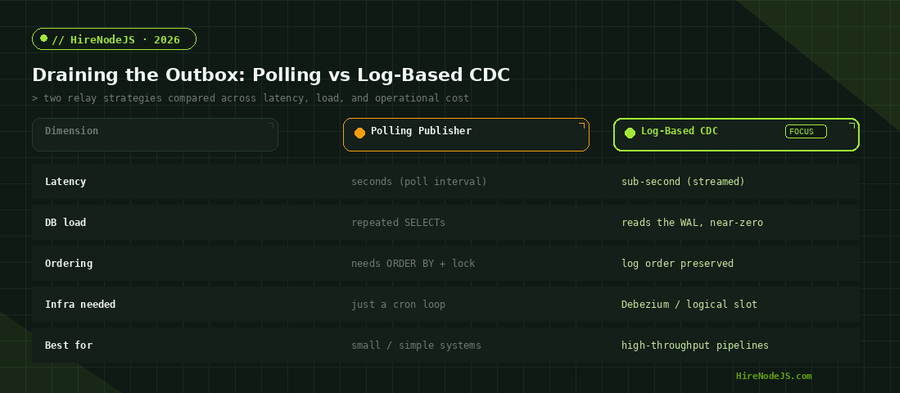
There are two mainstream ways to get rows out of the outbox and onto the broker, and the right choice depends entirely on your scale and latency budget.
Polling publishers
A polling relay — exactly the one above — runs on a timer and SELECTs unpublished rows. It is trivial to reason about, needs no extra infrastructure, and is the correct default for the vast majority of services. Its only real downsides are latency bounded by the poll interval and a steady stream of SELECT queries against the database, which matters only at high write rates.
Log-based change data capture
At high throughput, tailing the database's write-ahead log is dramatically more efficient. Tools like Debezium and the pg-transactional-outbox library use PostgreSQL logical decoding to stream every outbox insert to the broker as it is written — sub-second latency, near-zero query load, and log order preserved for free. The cost is operational complexity: a replication slot to manage, a connector to run, and more moving parts to monitor. The chart below shows how the two strategies diverge as write throughput climbs.
Idempotency and At-Least-Once Delivery
The outbox guarantees that every event is delivered at least once. It does not — and cannot, cheaply — guarantee exactly once. A relay can crash after publishing but before marking the row sent, so the same event will be republished on restart. This is not a flaw to engineer around; it is the contract. Your job is to make consumers tolerate duplicates.
Make consumers idempotent
Give every outbox event a stable unique id and have each consumer record the ids it has already processed, skipping any it has seen before. A small processed_events table with a unique constraint, or a Redis SET with a TTL, is usually enough. With idempotent consumers, at-least-once delivery becomes effectively exactly-once from the business's point of view — without any of the cost or fragility of true distributed two-phase commit.
Production Pitfalls and Operational Tips
Ordering is per-aggregate, not global
If two events for the same order must be processed in order, you must preserve that order through the relay and the broker — typically by partitioning on the aggregate id. Do not assume global ordering across all events; at scale it is neither achievable nor necessary, and pretending otherwise creates a throughput ceiling.
Watch the outbox table size
Published rows are dead weight. A janitor job that deletes or archives rows older than a retention window keeps the relay query fast and the table small. Pair it with monitoring on the count of unpublished rows: a steadily growing backlog is the earliest signal that your relay has stalled or the broker is rejecting writes.
Test the crash, not just the happy path
The whole point of the outbox is correct behavior under failure, so your tests should kill the process between the commit and the publish and assert that the event still arrives. Fault injection is the only way to prove the guarantee holds. Teams that skip this ship an outbox that is no more reliable than the dual-write it replaced.
Getting all of this right — the atomic write, a relay that scales, idempotent consumers, and the operational hygiene around table growth and ordering — is genuinely hard, and it is exactly where experienced engineers earn their keep. If you are building reliable event-driven systems and want people who have done it before, HireNodeJS connects you with pre-vetted senior Node.js developers available within 48 hours, without the recruiter overhead.
Hire Expert Node.js Developers — Ready in 48 Hours
Building the right system is only half the battle — you need the right engineers to build it. HireNodeJS.com specialises exclusively in Node.js talent: every developer is pre-vetted on real-world projects, API design, event-driven architecture, and production deployments.
Unlike generalist platforms, our curated pool means you speak only to engineers who live and breathe Node.js. Most clients have their first developer working within 48 hours of getting in touch. Engagements start as short-term contracts and can convert to full-time hires with zero placement fee.
Conclusion
The transactional outbox pattern trades a tiny amount of extra schema and a background relay for something invaluable: the certainty that no event is ever silently lost. By writing the event inside the same transaction as the data that produced it, you turn an impossible distributed-atomicity problem into an ordinary database write, then drain it asynchronously with a polling loop or log-based CDC depending on your scale.
In 2026, with event-driven architectures now the default for any system above a handful of services, the outbox is no longer an advanced trick — it is table stakes for reliability. Implement it early, make your consumers idempotent, watch the table size, and test the crash path. Do that, and your events will arrive even when everything else is on fire.
Frequently Asked Questions
What is the transactional outbox pattern in Node.js?
It is a reliability pattern where you write a domain event into an outbox table inside the same database transaction as your business data. A separate relay process then publishes those events to a message broker, guaranteeing no event is lost even if the app crashes.
How does the outbox pattern solve the dual-write problem?
The dual-write problem happens because a database commit and a broker publish are not atomic. The outbox makes them atomic by storing the event in the database with the business row, so a single commit covers both. Publishing then becomes a safe, retryable background step.
Does the transactional outbox guarantee exactly-once delivery?
No. It guarantees at-least-once delivery. A relay can publish an event and crash before marking it sent, so the event may be delivered twice. You make consumers idempotent — usually with a unique event id — so duplicates have no effect.
Should I use polling or change data capture to drain the outbox?
Start with a polling relay; it is simple and works for most workloads. Move to log-based CDC with tools like Debezium or pg-transactional-outbox when you need sub-second latency or want to remove the constant SELECT load at high write throughput.
Which database is best for the outbox pattern?
Any database with strong transactional guarantees works, but PostgreSQL is the most popular choice because of its robust transactions and mature logical decoding support, which makes log-based CDC straightforward.
How do I stop the outbox table from growing forever?
Run a janitor job that deletes or archives rows whose published_at timestamp is older than a short retention window, and add an index supporting the relay query. Monitor the count of unpublished rows to catch a stalled relay early.
Vivek Singh is the founder of Witarist and HireNodeJS.com — a platform connecting companies with pre-vetted Node.js developers. With years of experience scaling engineering teams, Vivek shares insights on hiring, tech talent, and building with Node.js.
Building microservices? Hire architects who've done it at scale.
HireNodeJS connects you with pre-vetted senior Node.js engineers who have shipped event-driven systems, outbox relays, and CDC pipelines in production — available within 48 hours, no recruiter fees.