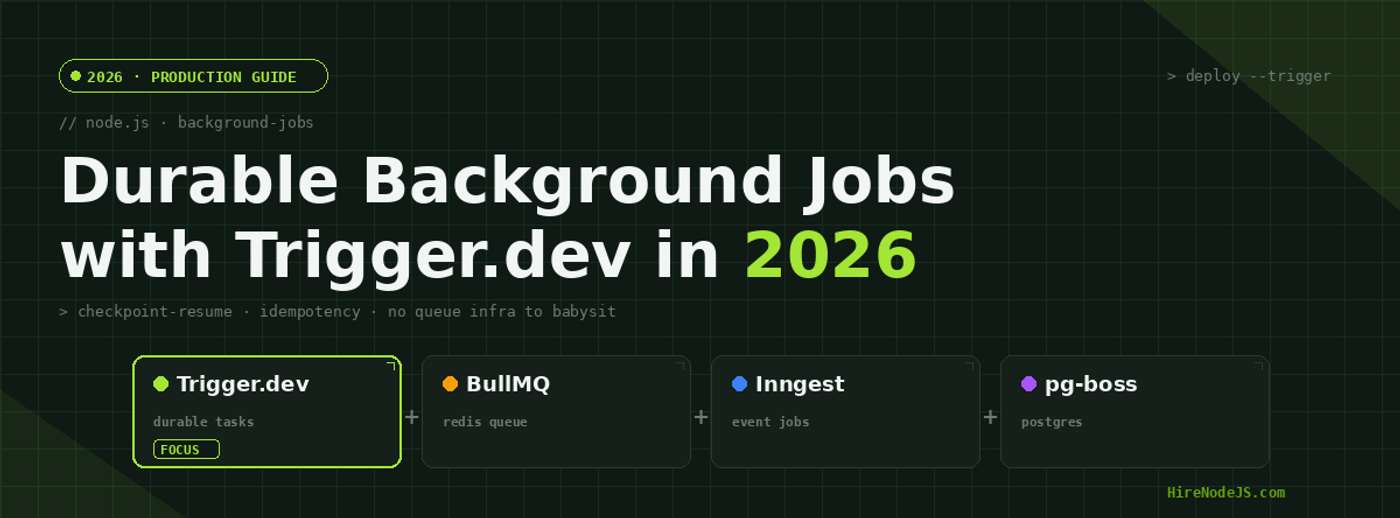
Node.js Background Jobs with Trigger.dev in 2026
Background jobs are where most Node.js systems quietly go to die. The endpoint returns 200, the queue swallows the work, and then a deploy, a crash, or a rate-limited third-party API silently drops a payment, an email, or a data sync - and nobody notices until a customer complains. In 2026 the bar for backend reliability has moved: workflows are expected to survive restarts, deploys, and hours-long waits without losing state.
That shift - from fire-and-forget queues to durable execution - is exactly what Trigger.dev was built for. It runs your Node.js tasks in managed containers, checkpoints every step, and resumes from the last successful point after any failure. This guide walks through how it works, when it beats classic queues like BullMQ, and the production patterns you need before you ship. If you are scaling a backend team around this, you can also hire backend developers who have run durable workflows in production.
Why Durable Execution Matters in 2026
The fire-and-forget problem
A traditional job queue gives you at-least-once delivery and not much else. If your worker crashes halfway through a multi-step workflow - charge the card, wait for a webhook, send a receipt - you are left with partial state. Re-running the whole job risks double charges; skipping it risks lost work. Teams end up hand-rolling idempotency tables, dead-letter queues, and reconciliation scripts just to make ordinary business logic trustworthy.
What durable actually buys you
Durable execution means the runtime persists the state of a workflow after every step. A crash, a deploy, or a deliberate multi-hour pause does not lose progress: the engine reloads the checkpoint and continues from the next instruction. You write linear, readable code - including literal sleeps measured in hours or days - and the platform handles the survival mechanics underneath. The result is fewer bespoke reliability hacks and far less 3 a.m. debugging.
What Trigger.dev Actually Does
Tasks, not cron scripts
In Trigger.dev v3 the unit of work is a task: an exported function with an id, retry policy, and a run handler. You trigger it from anywhere in your app - an API route, another task, or a schedule - and the platform queues, executes, and tracks each run with full logs and a timeline. There is no separate worker fleet to provision; each run executes in a fresh, isolated Node.js container that scales with demand.
No infrastructure to babysit
This is the biggest day-to-day difference from a Redis-backed queue. With BullMQ you own the Redis cluster, the worker processes, memory limits, and the on-call rotation when a node falls over. Trigger.dev's managed cloud removes that operational surface entirely, while still offering an Apache-2.0 self-hosted option if you need to run it in your own VPC.
Setting Up Your First Trigger.dev Task
Installation is a single SDK plus a config file; the CLI handles deploys. The task below shows the shape of a real durable workflow - a charge, a 24-hour wait, and a receipt email - where every step is checkpointed and the long wait costs you nothing in compute because no process stays alive during it.
import { task, logger, wait } from "@trigger.dev/sdk/v3";

// A durable task: each step is checkpointed, so a crash, deploy,
// or rate-limit pause resumes exactly where it left off.
export const processInvoice = task({
  id: "process-invoice",
  retry: { maxAttempts: 5, factor: 2, minTimeoutInMs: 1000 },
  run: async (payload: { invoiceId: string }, { ctx }) => {
    logger.info("Starting invoice", { id: payload.invoiceId, run: ctx.run.id });

    // Step 1 - charge the customer (idempotency key prevents double charges)
    const charge = await chargeCustomer(payload.invoiceId, {
      idempotencyKey: `charge-${payload.invoiceId}`,
    });

    // Step 2 - wait 24h for the receipt window, then email.
    // The worker is checkpointed and freed; no process stays alive.
    await wait.for({ hours: 24 });

    // Step 3 - generate + send the receipt
    const pdf = await renderReceipt(charge.id);
    await sendEmail(charge.email, pdf);

    return { charged: charge.amount, receiptSent: true };
  },
});
Notice the idempotency key on the charge step. If the task retries after the email step fails, the charge will not run twice - the engine returns the cached result of the already-completed step. That single guarantee eliminates an entire category of reconciliation bugs.
Checkpoint-Resume: How Durability Works
Every step is a save point
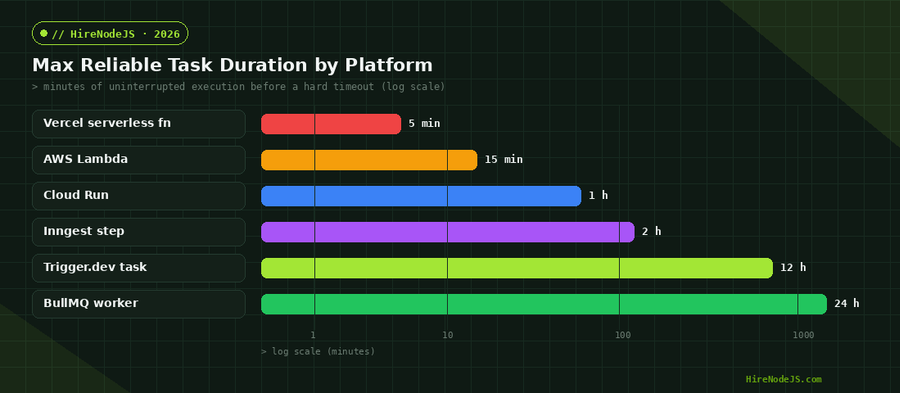
Under the hood, Trigger.dev wraps each await on a tracked operation as a checkpoint. When a step completes, its result is persisted; the container can then be torn down and recreated later without re-running prior work. This is what lets a single task span minutes or hours of real time without holding a server hostage - and it is why managed durable platforms reach far longer reliable task durations than raw serverless functions.
Surviving deploys and crashes
Hire Pre-Vetted Node.js Developers
Skip the months-long search. Our exclusive talent network has senior Node.js experts ready to join your team in 48 hours.
Because state lives in the engine and not in process memory, an in-flight run survives a deploy: the new version picks up the checkpoint and continues. A hard crash triggers the retry policy, replaying only the failed step. The chart below shows how the practical ceiling on uninterrupted task duration compares across common execution environments.
Trigger.dev vs BullMQ, Inngest, and pg-boss
Where each one wins
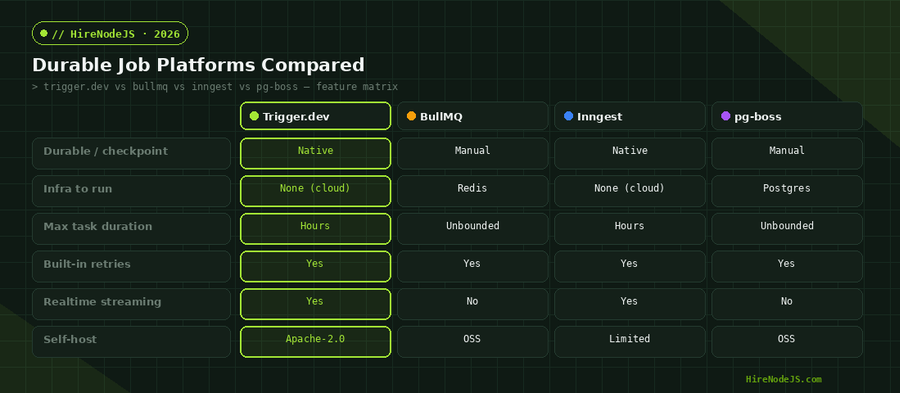
BullMQ remains the right call when you already run Redis and want maximum control over throughput and worker placement. pg-boss is ideal when Postgres is your only datastore and you want jobs in the same transaction as your data. Inngest, like Trigger.dev, is event-and-durability-first and managed. Trigger.dev's edge is the combination of long-running durable tasks, real-time streaming back to your UI, and an Apache-2.0 self-host path.
A simple decision rule
If your jobs are short, high-volume, and you already operate Redis, BullMQ is hard to beat on cost. If your workflows are multi-step, long-running, or need human-in-the-loop pauses, a durable engine like Trigger.dev pays for itself in deleted reliability code. The cost picture flips with scale, which is worth modeling explicitly before you commit.
Production Patterns: Retries, Concurrency, and Idempotency
Tune retries to the failure mode
Exponential backoff with jitter is the default for transient errors, but not every failure deserves a retry. A 400 from a payment provider is a permanent failure - retrying just burns attempts. Wrap non-retryable errors so the engine fails fast and surfaces them, and reserve retries for timeouts, 429s, and 5xxs.
Concurrency and rate limits
Trigger.dev lets you cap concurrency per task and per queue, which is the cleanest way to respect a downstream API's rate limit without a separate token-bucket service. Pair that with idempotency keys and your workflows become safe to retry aggressively. Teams that get this right ship far fewer incidents - and it is a core thing to probe for when you hire Node.js developers.
Build In-House or Hire Durable-Workflow Experience?
Adopting durable execution is as much an architectural decision as a tooling one, and the failure modes are subtle - partial side-effects, retry storms, and idempotency gaps only show up under production load. If your team has not run durable workflows before, the fastest path is to bring in engineers who have. HireNodeJS connects you with pre-vetted senior Node.js engineers - available within 48 hours - who have shipped queue and durable-execution systems at scale, so you skip the expensive learning-by-incident phase. You can also read how the process works before you commit.
Hire Expert Node.js Developers - Ready in 48 Hours
Building the right system is only half the battle - you need the right engineers to build it. HireNodeJS.com specialises exclusively in Node.js talent: every developer is pre-vetted on real-world projects, API design, event-driven architecture, and production deployments.
Unlike generalist platforms, our curated pool means you speak only to engineers who live and breathe Node.js. Most clients have their first developer working within 48 hours of getting in touch. Engagements start as short-term contracts and can convert to full-time hires with zero placement fee.
Conclusion: Durable by Default
Durable execution has gone from a niche pattern to the default expectation for serious Node.js backends in 2026. Trigger.dev makes it approachable: write linear task code, get checkpoint-resume, retries, idempotency, and real-time streaming without standing up a queue cluster. For short, Redis-heavy workloads, BullMQ still earns its place - but for multi-step, long-running, or human-in-the-loop workflows, a durable engine deletes an enormous amount of reliability code.
Start with one painful background job - the one that keeps dropping work - port it to a durable task, and measure the incidents that disappear. From there, the pattern tends to spread across the codebase on its own.
Frequently Asked Questions
What is the best way to run durable background jobs in Node.js?
Use a durable execution engine like Trigger.dev that checkpoints every step. Your task code stays linear while the platform handles retries, resumes after crashes, and survives deploys without losing state.
How is Trigger.dev different from BullMQ?
BullMQ is a Redis-backed queue you host and operate yourself, ideal for short high-volume jobs. Trigger.dev is a managed durable engine with checkpoint-resume, long-running tasks, and real-time streaming - no Redis cluster to babysit.
Does Trigger.dev support self-hosting?
Yes. Trigger.dev is Apache-2.0 licensed and can be self-hosted in your own infrastructure, or used as the managed Trigger.dev Cloud service if you prefer zero ops.
How long can a Trigger.dev task run?
Tasks can run for hours and can pause for days using the wait API without holding a process open, because each step is checkpointed and the container is freed during long waits.
How much does it cost to hire a Node.js developer for durable workflows in 2026?
Senior Node.js engineers with queue and durable-execution experience typically range from $40-$90 per hour depending on region. HireNodeJS connects you with pre-vetted developers available within 48 hours.
Is durable execution overkill for simple jobs?
For short, fire-and-forget tasks at high volume, a lightweight queue like BullMQ or pg-boss is often cheaper. Durable engines shine for multi-step, long-running, or human-in-the-loop workflows where lost state is costly.
Vivek Singh is the founder of Witarist and HireNodeJS.com — a platform connecting companies with pre-vetted Node.js developers. With years of experience scaling engineering teams, Vivek shares insights on hiring, tech talent, and building with Node.js.
Building durable Node.js workflows? Hire engineers who've shipped them.
HireNodeJS connects you with pre-vetted senior Node.js engineers experienced in queues, durable execution, and event-driven systems - available within 48 hours. No recruiter fees, no lengthy screening.