Node.js + tRPC in 2026: End-to-End Type-Safe APIs
If you build Node.js services for a TypeScript monorepo, you have probably hit the same wall twice: REST forces you to keep client types in sync with server contracts by hand, and GraphQL forces a whole code-generation pipeline before a developer can ship a single endpoint. tRPC removes both problems by letting your client import the server router type directly — no schemas to write, no codegen to wire up, just inferred types from the function signature.
By 2026, tRPC has become the default API style for product teams running TypeScript on both ends of the wire. This guide walks through everything a Node.js team needs to ship a tRPC backend in production: setup with Express or Fastify, building procedures with Zod, layering authentication through middleware, performance tuning with batching, and operational concerns like rate limiting and observability.
Why tRPC Matters for Node.js Teams in 2026
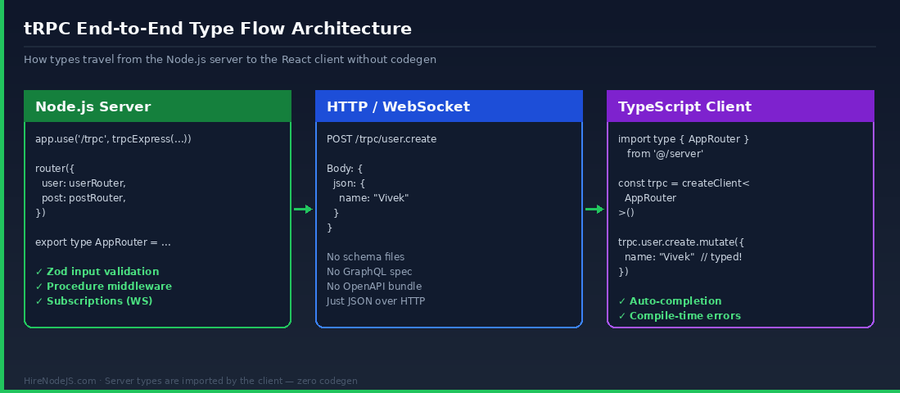
The promise of tRPC is simple: a function call on the client behaves exactly like a function call on the server, with the same arguments, the same return type, and the same compile-time errors. There is no schema language between them — the AppRouter type does all the work. For a small team shipping a TypeScript product, that one design decision quietly removes an entire layer of accidental complexity.
Three forces driving adoption
First, TypeScript adoption in Node.js codebases crossed 80% in the most recent State of JS survey, which means the type-safety win actually applies to most teams. Second, the React Query and TanStack ecosystems now treat tRPC as a first-class citizen — useQuery, useMutation, and useInfiniteQuery hooks come pre-typed. Third, edge runtimes (Cloudflare Workers, Vercel Edge, Bun) all ship official tRPC adapters, so the same router runs anywhere.
Where tRPC does not fit
tRPC is not for public REST APIs that third parties consume — those still want OpenAPI. It is also overkill if you only have one client and one endpoint. The sweet spot is internal Node.js services consumed by your own TypeScript clients (web, mobile, CLIs). For more general guidance on building modern Node.js APIs, see our Node.js skill page for the patterns we look for when vetting engineers.
tRPC vs REST vs GraphQL: A Practical Comparison
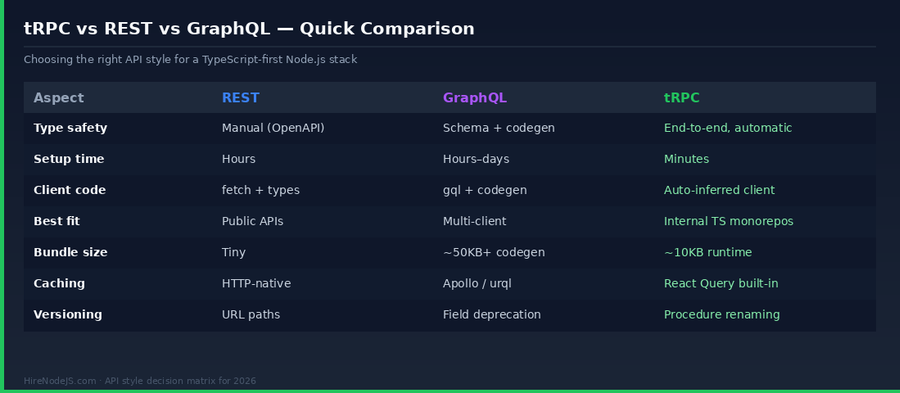
REST is mature, cacheable, and trivially debuggable with curl. GraphQL gives clients precise control over the shape of the response and works well across heterogeneous clients. tRPC trades the public-API ceremony of both for speed of internal development. The chart below scores each style across six dimensions a Node.js team usually cares about.
Decision matrix
If your API is consumed by browsers you do not control, ship REST or GraphQL. If your client is a TypeScript monorepo cousin of the server, tRPC will save you weeks per quarter. Some teams run both: a tRPC router for the in-house web app and an OpenAPI gateway for partners — the same business logic backs both surfaces.
Setting Up tRPC with Express or Fastify
Most production Node.js teams already have an Express or Fastify app, so the easiest tRPC integration is to mount it as a single route and let it handle everything underneath. The setup takes under twenty lines for either framework. Below is a working Express setup that you can paste into a fresh project.
import express from 'express';
import { initTRPC } from '@trpc/server';
import * as trpcExpress from '@trpc/server/adapters/express';
import { z } from 'zod';

// 1. Create the tRPC instance
const t = initTRPC.context<{ userId?: string }>().create();
export const router = t.router;
export const publicProcedure = t.procedure;

// 2. Define a router with one query and one mutation
const appRouter = router({
  user: router({
    byId: publicProcedure
      .input(z.object({ id: z.string().uuid() }))
      .query(async ({ input }) => {
        return { id: input.id, name: 'Vivek', joinedAt: new Date() };
      }),

    create: publicProcedure
      .input(z.object({ name: z.string().min(2), email: z.string().email() }))
      .mutation(async ({ input }) => {
        // ...persist to your DB here
        return { ok: true, id: crypto.randomUUID(), ...input };
      }),
  }),
});

// 3. Export the type the client will import — no codegen required
export type AppRouter = typeof appRouter;

// 4. Mount on Express
const app = express();
app.use(
  '/trpc',
  trpcExpress.createExpressMiddleware({
    router: appRouter,
    createContext: ({ req }) => ({ userId: req.headers['x-user-id'] as string | undefined }),
  })
);

app.listen(3000, () => console.log('tRPC server on :3000'));Wiring up the client
On the client, you import the AppRouter type and pass it to createTRPCClient. Calls like trpc.user.byId.query({ id }) are fully typed against the server. With React Query, the same router type flows into useQuery and useMutation hooks for caching, retries, and optimistic updates.
Building Type-Safe Procedures and Routers
A tRPC router is just a tree of procedures. You can nest routers as deep as you want, mix queries and mutations, and split files freely — the inferred AppRouter type stitches everything back together. The pattern most teams settle on is one router file per domain (user, post, billing) merged at the top level.
Inputs, outputs, and inference
Hire Pre-Vetted Node.js Developers
Skip the months-long search. Our exclusive talent network has senior Node.js experts ready to join your team in 48 hours.
Every procedure exposes its inferred input and output types via the AppRouter type. Tools like @trpc/react-query turn that into hooks that already know what arguments to expect and what shape will come back. You almost never write a manual TypeScript type for an API call again.
Subscriptions and streaming
tRPC supports server-sent events and WebSockets through the subscription procedure type. The contract is the same — a typed input, a typed output observable — so a real-time feed feels identical to a regular query from the client's perspective.
Handling Authentication and Middleware
Authentication in tRPC is just middleware. You attach context (a user object, a request ID, a tenant) in createContext, then write a middleware procedure that gates access. Because middleware runs through the same procedure builder, downstream procedures inherit the narrowed types — protectedProcedure can declare ctx.user is non-null, and TypeScript will enforce it everywhere.
import { TRPCError } from '@trpc/server';

const isAuthed = t.middleware(({ ctx, next }) => {
  if (!ctx.userId) {
    throw new TRPCError({ code: 'UNAUTHORIZED' });
  }
  // Narrow the context so downstream procedures see ctx.userId as string
  return next({ ctx: { ...ctx, userId: ctx.userId } });
});

export const protectedProcedure = t.procedure.use(isAuthed);

// Now any procedure built from protectedProcedure is auth-gated AND type-narrowed
const meRouter = router({
  whoami: protectedProcedure.query(({ ctx }) => ({ id: ctx.userId })),
});Performance, Caching, and Batching
tRPC ships with built-in request batching: the client can collect multiple procedure calls into a single HTTP request, which dramatically reduces latency for waterfall-heavy pages. Pair that with React Query's stale-while-revalidate caching and you rarely need a separate caching layer in the browser. On the server, the usual Node.js patterns apply — Redis, in-memory LRU, and CDN edges. We covered those depth-first in our Node.js caching guide.
Batching gotchas
Batching is great for parallel reads, but it can hide N+1 query problems on the server because all sub-calls hit the same handler. Use DataLoader inside procedures that fan out to a database, and add an explicit context-level cache for tenant lookups. If a procedure can take more than 100 ms, opt it out of batching and call it as a standalone request.
Production Deployment and Observability
Running tRPC in production looks the same as any other Node.js service — process manager, structured logs, traces, and graceful shutdown. The only tRPC-specific addition is a request logger middleware that records procedure name, input shape, duration, and error code per call. That data plugs straight into the same OpenTelemetry pipeline most teams already run; we wrote about that in detail in our Node.js observability guide.
Rate limiting and abuse protection
Because every tRPC call goes through a single HTTP route, you can apply rate limits at the Express or Fastify layer with libraries like express-rate-limit or @fastify/rate-limit. For per-procedure throttling, write a tRPC middleware that reads the procedure path from ctx and decrements a Redis counter. Reject with a TRPCError of code TOO_MANY_REQUESTS so the client maps it to an HTTP 429.
Setting up tRPC in a hello-world repo takes an afternoon. Building a production stack with auth, caching, batching, observability, rate limiting, and a clean migration story from REST is months of focused work — and the patterns you choose will define how easy it is to onboard the next ten engineers. If you want a senior engineer who has already shipped tRPC at scale, HireNodeJS can introduce you to pre-vetted Node.js + TypeScript developers within 48 hours, with no recruiter overhead and no long screening loops.
Hire Expert Node.js Developers — Ready in 48 Hours
Building the right system is only half the battle — you need the right engineers to build it. HireNodeJS.com specialises exclusively in Node.js talent: every developer is pre-vetted on real-world projects, API design, event-driven architecture, and production deployments — including end-to-end TypeScript stacks like tRPC, NestJS, and GraphQL.
Unlike generalist platforms, our curated pool means you speak only to engineers who live and breathe Node.js. Most clients have their first developer working within 48 hours of getting in touch. Engagements start as short-term contracts and can convert to full-time hires with zero placement fee.
Final Thoughts
tRPC is not a silver bullet, but for Node.js teams that have already standardised on TypeScript and own both ends of the wire, it is the lowest-friction way to ship typed APIs in 2026. The pattern is simple to start with — a router, a few procedures, an exported type — and scales cleanly with middleware, batching, and observability borrowed from the rest of the Node.js ecosystem.
Start by porting one isolated feature to tRPC inside an existing Express or Fastify app. Measure the developer-experience win in real PRs, then expand the router as confidence grows. The version of your codebase six months from now will spend a lot less time arguing about API contracts.
Frequently Asked Questions
What is tRPC and why is it popular for Node.js in 2026?
tRPC is a TypeScript-first RPC framework that lets a client import the server router type directly, giving end-to-end type safety with no schema files or codegen step. It is popular because most Node.js teams now use TypeScript on both ends of the wire and want the productivity win without the GraphQL ceremony.
Should I use tRPC instead of REST or GraphQL?
Use tRPC for internal APIs consumed by your own TypeScript clients — web, mobile, CLIs in the same monorepo. Stick with REST or GraphQL for public APIs that third parties consume, where stable, language-agnostic schemas matter more than developer experience.
Does tRPC work with Express, Fastify, or serverless platforms?
Yes. tRPC ships official adapters for Express, Fastify, Next.js, AWS Lambda, Cloudflare Workers, Vercel Edge, and Bun. The same router runs across all of them — only the adapter glue changes.
How does authentication work in tRPC?
Authentication is done with middleware. You attach a user (or null) to the request context in createContext, then use a procedure middleware to throw UNAUTHORIZED if no user is present. Downstream procedures inherit the narrowed type so ctx.user is non-null.
Is tRPC fast enough for production traffic?
Yes. The runtime is roughly 10 KB and adds negligible overhead per call. Built-in request batching collapses parallel calls into one HTTP request, and standard Node.js performance tooling — caching, clustering, edge deployment — applies the same as for any framework.
How long does it take to migrate from REST to tRPC?
Most teams pilot tRPC on a single feature in an existing Express or Fastify app within a day. A full migration usually rolls out endpoint-by-endpoint over a few weeks because the two styles can co-exist on the same Node.js process.
Vivek Singh is the founder of Witarist and HireNodeJS.com — a platform connecting companies with pre-vetted Node.js developers. With years of experience scaling engineering teams, Vivek shares insights on hiring, tech talent, and building with Node.js.
Want a TypeScript + Node.js expert who has shipped tRPC in production?
HireNodeJS connects you with pre-vetted senior Node.js + TypeScript engineers in 48 hours — no recruiter fees, no lengthy screening, just developers who already know how to build end-to-end type-safe APIs.