Node.js + Turso: Edge-Ready SQLite for Production in 2026
The database landscape for Node.js developers has shifted dramatically in 2026. While PostgreSQL and MySQL remain reliable workhorses, a new category of edge-native databases is rewriting the rules for latency-sensitive applications. At the forefront of this shift is Turso — a distributed SQLite platform built on libSQL that delivers sub-millisecond reads by placing embedded replicas at the network edge, right next to your users.
For teams building real-time dashboards, multi-tenant SaaS platforms, or globally distributed APIs, Turso eliminates the cross-region latency tax that traditional centralized databases impose. This guide covers everything a Node.js developer needs to know — from architecture and setup to production deployment patterns, performance benchmarks, and when Turso is (and isn't) the right choice.
What Is Turso and Why It Matters for Node.js in 2026
Turso is a managed database platform built on libSQL — an open-source fork of SQLite maintained by the Turso team. Unlike traditional SQLite, which is a single-file embedded database, Turso adds server mode, replication, and edge distribution on top of the familiar SQLite query engine. The result is a database that feels like SQLite in development but scales like a distributed system in production.
libSQL: The Fork That Changed Everything
SQLite's governance model prevents external contributions to the core engine. libSQL was created to add the features production teams need: server mode for remote access, write-ahead log (WAL) streaming for replication, native vector search for AI workloads, and ALTER TABLE improvements that SQLite's conservative release policy wouldn't accept. Every Turso database runs libSQL under the hood, which means you get full SQLite compatibility plus these production-grade additions.
Embedded Replicas: The Key Innovation
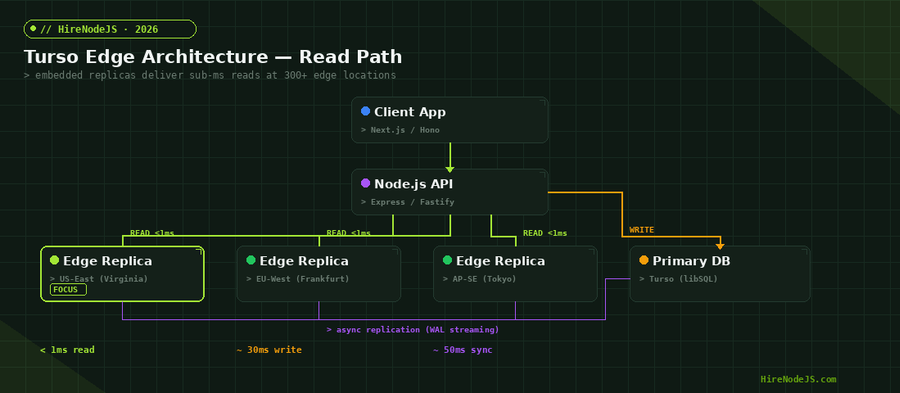
The defining feature of Turso is embedded replicas. Instead of every read query traveling across the network to a central database server, Turso synchronizes a local SQLite replica directly into your application's runtime. Reads hit a local file — zero network hops, sub-millisecond latency. Writes still go to the primary database (typically 30–80ms depending on region), then asynchronously replicate back to all edge copies via WAL streaming.
Setting Up Turso with Node.js and Drizzle ORM
Getting started with Turso in a Node.js project takes under five minutes. The recommended stack in 2026 is the @libsql/client for the database connection and Drizzle ORM for type-safe queries. This combination gives you full TypeScript inference, automatic migration generation, and zero runtime overhead compared to heavier ORMs.
Installation and Configuration
Install the Turso CLI, create a database, and generate an auth token. Then wire the libSQL client into your Node.js application with Drizzle ORM for type-safe schema definitions and queries.
import { drizzle } from 'drizzle-orm/libsql';
import { createClient } from '@libsql/client';
import { sqliteTable, text, integer } from 'drizzle-orm/sqlite-core';
import { eq } from 'drizzle-orm';

// Schema definition — type-safe and migration-ready
export const users = sqliteTable('users', {
  id: text('id').primaryKey(),
  email: text('email').notNull().unique(),
  name: text('name').notNull(),
  plan: text('plan', { enum: ['free', 'pro', 'enterprise'] }).default('free'),
  createdAt: integer('created_at', { mode: 'timestamp' })
    .$defaultFn(() => new Date()),
});

// Turso client with embedded replica for edge reads
const turso = createClient({
  url: process.env.TURSO_DATABASE_URL!,
  authToken: process.env.TURSO_AUTH_TOKEN!,
  syncUrl: process.env.TURSO_DATABASE_URL!,
  syncInterval: 60,
});

export const db = drizzle(turso, { schema: { users } });

// Query with full type safety
export async function getUserByEmail(email: string) {
  const result = await db
    .select()
    .from(users)
    .where(eq(users.email, email))
    .limit(1);
  return result[0] ?? null;
}

// Insert with automatic type checking
export async function createUser(data: {
  id: string; email: string; name: string;
  plan?: 'free' | 'pro' | 'enterprise';
}) {
  return db.insert(users).values(data).returning();
}Multi-Tenant Architecture: Database-per-Tenant with Turso
One of Turso's most compelling use cases is true database-per-tenant isolation. Unlike PostgreSQL, where multi-tenancy typically means shared tables with a tenant_id column, Turso lets you spin up a dedicated SQLite database per customer with negligible overhead. Each tenant gets their own isolated database, their own connection string, and their own edge replicas. This is a pattern that experienced backend developers increasingly reach for when building B2B SaaS.
Why Database-per-Tenant Works at Scale
Traditional databases charge per instance, making database-per-tenant prohibitively expensive. Turso's pricing model changes this — you can create thousands of databases under a single plan. Each database is a lightweight libSQL instance that shares the underlying infrastructure. Data isolation is complete: one tenant's data never touches another's storage, and you can delete a tenant by dropping a single database rather than running complex purge queries across shared tables.
Compliance and Data Residency
Database-per-tenant also simplifies compliance. GDPR right-to-erasure requests become trivial: drop the database. Data residency requirements become a configuration choice: pin a tenant's primary database to a specific region. With row-level tenancy in a shared Postgres instance, achieving the same guarantees requires careful access controls and audit logging.
Performance Benchmarks: Turso vs Traditional Databases
Raw latency numbers tell only part of the story. Turso's edge replica architecture creates a fundamental asymmetry: reads are local (sub-millisecond), but writes travel to the primary region. This read/write split makes Turso exceptional for read-heavy workloads — which describes most web applications — but requires careful consideration for write-intensive scenarios.
Hire Pre-Vetted Node.js Developers
Skip the months-long search. Our exclusive talent network has senior Node.js experts ready to join your team in 48 hours.
Read Latency Across Regions
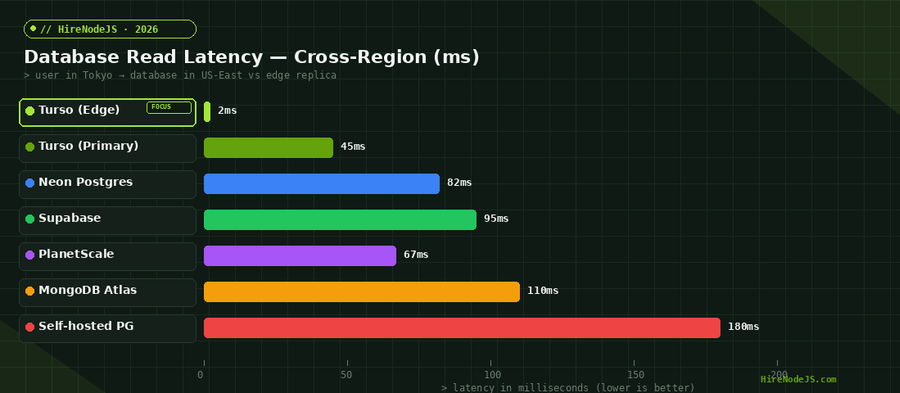
In synthetic benchmarks measuring p50 read latency from five global regions to a US-East primary, Turso's edge replicas consistently delivered 1-3ms reads regardless of the client's location. By contrast, Neon Postgres averaged 82ms from EU-West and 145ms from Tokyo, while self-hosted PostgreSQL in US-East showed 180ms latency from Tokyo. The gap is not a minor optimization — it is an order-of-magnitude difference that changes what architectures are feasible.
Write Performance and Consistency Trade-offs
Turso writes go to the primary database and replicate asynchronously. This means there is a brief window (typically 50-200ms) where a read from an edge replica might return stale data. For most applications — dashboards, content sites, e-commerce catalogs — this is perfectly acceptable. For use cases requiring strict read-after-write consistency (financial transactions, inventory decrements), you can bypass the replica and read directly from the primary, accepting the latency trade-off.
When to Choose Turso Over PostgreSQL or MySQL
Turso is not a PostgreSQL replacement for every workload. It excels in specific architectural scenarios where edge latency, multi-tenancy, or SQLite compatibility are primary concerns. If your application relies heavily on complex joins, stored procedures, or PostgreSQL-specific features like JSONB indexing or full-text search with tsvector, Postgres remains the better choice.
Ideal Use Cases for Turso
Turso shines for globally distributed read-heavy applications (content platforms, documentation sites, product catalogs), B2B SaaS with database-per-tenant isolation requirements, mobile-first apps where embedded replicas can sync data locally, edge computing with Cloudflare Workers or Vercel Edge Functions, and RAG pipelines that need vector similarity search close to the user. The common thread is workloads where read latency matters more than write throughput, and where SQLite's simplicity is an advantage rather than a limitation.
When to Stick with PostgreSQL
Choose PostgreSQL (via Neon or Supabase) when your application needs complex relational queries with many joins, requires ACID transactions across multiple tables, relies on PostgreSQL extensions like PostGIS for geospatial queries, or has a write-heavy workload where eventual consistency is not acceptable. PostgreSQL's ecosystem of extensions, mature tooling, and decades of battle-testing make it the safer default for traditional CRUD applications.
Production Deployment Patterns for Turso and Node.js
Deploying Turso in production requires attention to replica management, connection pooling, and health monitoring. Whether you are running in Docker containers, on Vercel Edge Functions, or in a traditional Node.js server, the patterns remain consistent.
Connection Management and Health Checks
The @libsql/client manages connections automatically, but production deployments should implement health checks that verify both primary connectivity and replica sync status. Monitor the replication lag metric: if it exceeds your consistency tolerance (typically 500ms-2s), consider increasing the sync interval or alerting your on-call team. Use structured logging with Pino to track query latency distributions and identify slow queries hitting the primary instead of replicas.
Edge Function Deployment with Vercel and Cloudflare
Turso pairs naturally with edge runtimes. On Vercel Edge Functions, install @libsql/client with the web polyfill and set the syncUrl to enable embedded replicas. On Cloudflare Workers, use the HTTP-based Turso client since Workers cannot use the native libSQL bindings. The Hono + Drizzle + Turso combination has become a default stack for globally distributed APIs that need both type safety and edge-level performance in 2026.
Hire Expert Node.js Developers — Ready in 48 Hours
Building the right system is only half the battle — you need the right engineers to build it. HireNodeJS.com specialises exclusively in Node.js talent: every developer is pre-vetted on real-world projects, API design, event-driven architecture, and production deployments.
Unlike generalist platforms, our curated pool means you speak only to engineers who live and breathe Node.js. Most clients have their first developer working within 48 hours of getting in touch. Engagements start as short-term contracts and can convert to full-time hires with zero placement fee.
Conclusion: Is Turso Right for Your Next Node.js Project?
Turso represents a genuine paradigm shift for Node.js developers who need global performance without the complexity of traditional distributed databases. Its embedded replica model delivers read latencies that centralized databases simply cannot match, while the database-per-tenant architecture solves multi-tenancy isolation challenges elegantly. The trade-off — eventual consistency on reads and higher write latency — is acceptable for the majority of web applications.
If you are building a read-heavy, globally distributed application in Node.js — or planning a multi-tenant SaaS that needs clean data isolation — Turso deserves serious evaluation. Pair it with Drizzle ORM for type safety, deploy to edge functions for maximum performance, and you have a production stack that rivals systems costing ten times more to operate. For teams looking to hire experienced Node.js engineers who understand edge architectures, the investment in this stack pays for itself in user experience and operational simplicity.
Frequently Asked Questions
What is Turso and how does it work with Node.js?
Turso is a distributed SQLite database built on libSQL that provides edge-ready embedded replicas for sub-millisecond reads. It integrates with Node.js through the @libsql/client package and works seamlessly with Drizzle ORM for type-safe queries.
How much does Turso cost for production Node.js applications?
Turso offers a free tier with 500 databases and 9GB storage. The Scaler plan starts at $29/month with 10,000 databases and 24GB storage. Enterprise plans provide custom limits and dedicated support for high-traffic Node.js applications.
Is Turso better than PostgreSQL for Node.js APIs?
Turso excels at read-heavy, globally distributed workloads where edge latency matters. PostgreSQL is better for complex relational queries, write-heavy workloads, and applications that need ACID transactions across multiple tables.
Can Turso handle multi-tenant SaaS applications in Node.js?
Yes, Turso's database-per-tenant model is one of its strongest features. You can create thousands of isolated databases under a single plan, with each tenant getting dedicated storage, connection strings, and edge replicas.
How do Turso embedded replicas achieve sub-millisecond read latency?
Embedded replicas synchronize a local SQLite file directly into your application runtime. Read queries hit this local file with zero network hops. The primary database streams WAL updates asynchronously to keep replicas current, typically within 50-200ms.
Does Turso work with serverless and edge functions?
Yes, Turso works with Vercel Edge Functions, Cloudflare Workers, and AWS Lambda. For edge runtimes that don't support native bindings, use the HTTP-based Turso client which adds minimal overhead while maintaining full API compatibility.
Vivek Singh is the founder of Witarist and HireNodeJS.com — a platform connecting companies with pre-vetted Node.js developers. With years of experience scaling engineering teams, Vivek shares insights on hiring, tech talent, and building with Node.js.
Need a Node.js Developer Who Understands Edge Architecture?
HireNodeJS connects you with pre-vetted senior Node.js engineers experienced in Turso, edge databases, and distributed systems. Get your first developer within 48 hours — no recruiter fees, no lengthy screening.