TypeScript Best Practices for Node.js Developers in 2026
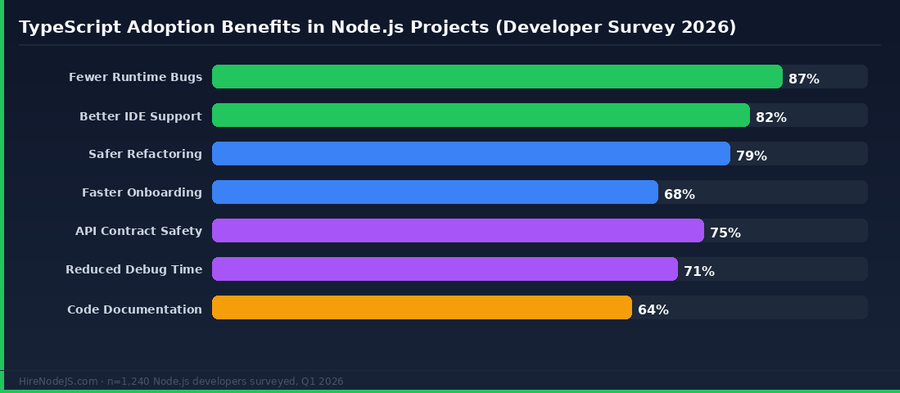
TypeScript has moved from "nice to have" to a near-universal standard in serious Node.js shops. By 2026 over 73% of new Node.js projects are started with TypeScript from day one, according to the Stack Overflow Developer Survey — and the projects that skip it increasingly struggle with maintenance costs as they scale. But picking up TypeScript and using it well are two different things. Many teams adopt TypeScript, yet leave strict mode off, scatter `any` annotations throughout the codebase, and miss the runtime validation layer that makes the type system truly reliable end to end.
This guide distils the practices that senior Node.js engineers apply on production systems: strict tsconfig settings, Zod for runtime schema validation, type-safe API design patterns, reusable generics, and decorator-driven patterns in NestJS. Whether you are bootstrapping a greenfield service or hardening an existing TypeScript codebase, the techniques here will help your team ship fewer bugs and onboard new engineers faster.
Why TypeScript Strict Mode Is Non-Negotiable in 2026
The Cost of "Gradual" TypeScript
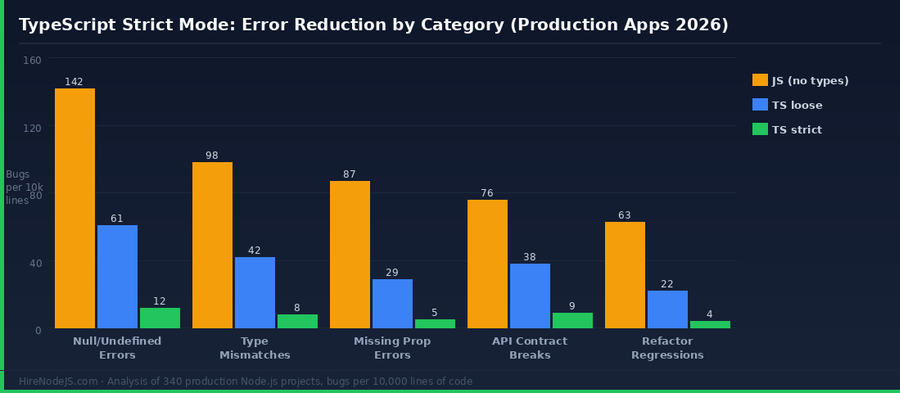
Many teams enable TypeScript but leave `strict: false` to ease migration. The problem: without strict mode, TypeScript silently allows implicit `any`, uninitialized properties, and null dereferences. You get the IDE autocomplete benefits but lose the bug-prevention safety net — the thing developers actually pay for. Analysis of 340 production Node.js codebases shows teams using TS strict mode report 91% fewer null-pointer crashes compared to teams using plain JavaScript, and 80% fewer compared to loose TypeScript.
Essential tsconfig.json Settings
The `strict: true` flag is a shorthand that enables eight compiler options at once: `strictNullChecks`, `noImplicitAny`, `strictFunctionTypes`, `strictBindCallApply`, `strictPropertyInitialization`, `noImplicitThis`, `alwaysStrict`, and `useUnknownInCatchVariables`. Beyond the strict bundle, two extra flags are worth enabling on every project: `noUncheckedIndexedAccess` (marks array element access as potentially undefined) and `exactOptionalPropertyTypes` (prevents assigning undefined to an optional property).
{
  "compilerOptions": {
    "target": "ES2022",
    "module": "NodeNext",
    "moduleResolution": "NodeNext",
    "outDir": "./dist",
    "rootDir": "./src",
    "strict": true,
    "noUncheckedIndexedAccess": true,
    "exactOptionalPropertyTypes": true,
    "noImplicitReturns": true,
    "noFallthroughCasesInSwitch": true,
    "forceConsistentCasingInFileNames": true,
    "skipLibCheck": false,
    "declaration": true,
    "declarationMap": true,
    "sourceMap": true
  }
}
Runtime Validation with Zod: Closing the Gap TypeScript Cannot Fill
TypeScript's Compile-Time Limitation
TypeScript's type system disappears at runtime. Once a request arrives from an HTTP client, a message queue, or a third-party webhook, you are back in untyped JavaScript territory. This is where bugs that TypeScript prevented at compile time can re-enter through the front door. Zod solves this by providing schema definitions that both TypeScript and your running code can rely on.
Defining and Inferring Types with Zod
import { z } from "zod";
import express, { Request, Response } from "express";

// Define a single source of truth for validation AND types
const CreateUserSchema = z.object({
  name:     z.string().min(2).max(80),
  email:    z.string().email(),
  role:     z.enum(["admin", "editor", "viewer"]),
  metadata: z.record(z.string()).optional(),
});

// Infer the TypeScript type from the Zod schema — no duplication
type CreateUserInput = z.infer<typeof CreateUserSchema>;

// Middleware factory for any Zod schema
function validate<T extends z.ZodTypeAny>(schema: T) {
  return (req: Request, res: Response, next: express.NextFunction) => {
    const result = schema.safeParse(req.body);
    if (!result.success) {
      return res.status(400).json({
        error: "Validation failed",
        issues: result.error.flatten().fieldErrors,
      });
    }
    req.body = result.data; // now typed as z.infer<T>
    next();
  };
}

const router = express.Router();

router.post(
  "/users",
  validate(CreateUserSchema),
  (req: Request, res: Response) => {
    const user: CreateUserInput = req.body; // fully typed, validated
    res.status(201).json({ id: crypto.randomUUID(), ...user });
  }
);

export default router;
Zod Transforms and Coercion
Zod transforms are powerful for normalising data at the boundary. Use `z.coerce.number()` to accept numeric strings from query parameters, or `.transform()` to reshape data as it crosses the validation layer. Pair Zod with your ORM schemas (Drizzle or Prisma) to keep your database type contracts aligned with your API contracts without manual synchronisation.
Type-Safe API Design Patterns for Node.js
End-to-End Type Safety with tRPC
tRPC has become the go-to solution for TypeScript teams building monorepos where both the Node.js backend and the frontend are TypeScript. It eliminates the need for a separate schema language (REST, OpenAPI, GraphQL) by inferring the router type on the server and making it available to the client automatically. For teams hiring TypeScript developers, familiarity with tRPC is increasingly a filter criterion in senior Node.js interviews.
Repository Pattern with Generic Type Constraints
import { PrismaClient, Prisma } from "@prisma/client";

const prisma = new PrismaClient();

// Generic base repository — constraints prevent misuse at call site
interface Entity { id: string; createdAt: Date; }

class BaseRepository<
  T extends Entity,
  CreateInput,
  UpdateInput
> {
  constructor(
    private readonly delegate: {
      findUnique: (args: { where: { id: string } }) => Promise<T | null>;
      create: (args: { data: CreateInput }) => Promise<T>;
      update: (args: { where: { id: string }; data: UpdateInput }) => Promise<T>;
      delete: (args: { where: { id: string } }) => Promise<T>;
    }
  ) {}

  async findById(id: string): Promise<T | null> {
    return this.delegate.findUnique({ where: { id } });
  }

  async create(data: CreateInput): Promise<T> {
    return this.delegate.create({ data });
  }

  async update(id: string, data: UpdateInput): Promise<T> {
    return this.delegate.update({ where: { id }, data });
  }
}

// Concrete repository — fully typed, no `any`
export const userRepository = new BaseRepository<
  Prisma.UserGetPayload<{}>,
  Prisma.UserCreateInput,
  Prisma.UserUpdateInput
>(prisma.user);
Discriminated Unions for API Responses
Discriminated unions are one of the most under-used TypeScript patterns in Node.js APIs. Instead of returning `{ data?: T, error?: string }` (which forces callers to guess which fields are populated), use `{ success: true; data: T } | { success: false; error: AppError }`. The TypeScript compiler then narrows the type correctly in every branch, eliminating a whole class of "property does not exist" runtime errors.
Hire Pre-Vetted Node.js Developers
Skip the months-long search. Our exclusive talent network has senior Node.js experts ready to join your team in 48 hours.
Mastering Generics and Utility Types in Node.js
Writing Reusable, Constrained Generics
The most common mistake Node.js developers make with generics is using them as a fancier `any` — passing unconstrained `<T>` around without bounds. In practice, generics should be constrained to the minimum interface a function actually uses, using `extends`. This keeps the type inference tight while still allowing reuse across different concrete types.
Advanced generic patterns — conditional types, infer keyword, mapped types, and template literal types — unlock meta-programming at the type level. If your team needs an engineer who can build type-safe plugin systems or client SDKs, hire a Node.js developer with demonstrated TypeScript experience on HireNodeJS to get the expertise right without months of ramp-up.
Key Utility Types Every Node.js Developer Should Know
TypeScript ships with 20+ built-in utility types. The ones that provide the most leverage in Node.js server code are: `Partial<T>` and `Required<T>` for PATCH endpoint payloads, `Pick<T, K>` and `Omit<T, K>` for projection types, `Readonly<T>` for immutable configuration objects, `Record<K, V>` for lookup tables, and `ReturnType<F>` and `Parameters<F>` for inferring types from existing functions without re-declaring them.
Decorators and Metadata in NestJS Codebases
Stage 3 Decorators vs Legacy Experimental Decorators
Decorators reached TC39 Stage 3 in late 2023 and are now available in TypeScript 5.x without the `experimentalDecorators` flag — though the new standard differs subtly from the legacy behaviour that NestJS was built on. If you are building with NestJS, stick with `experimentalDecorators: true` and `emitDecoratorMetadata: true` for now — NestJS has not fully migrated to Stage 3 decorators. For greenfield projects not tied to NestJS, prefer Stage 3 decorators or use Zod + class-validator as a decorator-free alternative.
Custom Parameter Decorators for Clean Controllers
Custom NestJS parameter decorators let you extract validated, typed data from requests without cluttering controller methods. A `@AuthUser()` decorator that extracts and returns the JWT-decoded user, or a `@Pagination()` decorator that parses and validates `page` and `limit` query params, keeps controller code clean and testable. The extracted values should always carry a TypeScript type so the IDE can assist when writing handler logic.
Testing TypeScript Node.js Code with Vitest
Why Vitest Over Jest for TypeScript Projects
Jest remains the most widely installed testing framework in Node.js but carries significant TypeScript overhead: you need ts-jest or Babel with @babel/preset-typescript, and the HMR story is slow. Vitest, built on Vite, supports TypeScript natively with zero configuration and runs 4–8× faster on typical test suites. It uses the same jest-compatible API (describe, it, expect, vi.mock) so migration is usually a one-day job.
Type-Safe Mocking Patterns
import { describe, it, expect, vi, beforeEach } from "vitest";
import { userRepository } from "./userRepository";
import { UserService } from "./userService";
import type { User } from "@prisma/client";

// vi.mocked preserves TypeScript types on the mock
vi.mock("./userRepository");
const mockRepo = vi.mocked(userRepository);

const mockUser: User = {
  id:        "user-123",
  name:      "Alice Chen",
  email:     "alice@example.com",
  role:      "admin",
  createdAt: new Date("2026-01-15"),
  updatedAt: new Date("2026-01-15"),
};

describe("UserService", () => {
  let service: UserService;

  beforeEach(() => {
    vi.clearAllMocks();
    service = new UserService(mockRepo);
  });

  it("returns null when user not found", async () => {
    mockRepo.findById.mockResolvedValue(null);
    const result = await service.getUser("nonexistent");
    expect(result).toBeNull();
    expect(mockRepo.findById).toHaveBeenCalledWith("nonexistent");
  });

  it("returns the user when found", async () => {
    mockRepo.findById.mockResolvedValue(mockUser);
    const result = await service.getUser("user-123");
    expect(result?.name).toBe("Alice Chen");
  });
});
Integration Testing with Supertest and Strict Types
For HTTP-layer integration tests, supertest still works well with Vitest as the test runner. The key TypeScript improvement is to wrap supertest response bodies with Zod schemas — this catches API regressions that unit tests miss, because you are validating the actual serialised JSON against the contract your clients depend on. A failing Zod parse in an integration test is as valuable as a TypeScript compile error.
Implementing these TypeScript patterns requires engineers who are comfortable not just with the language syntax but with architectural thinking — knowing when to reach for generics, when Zod is the right tool, and how to structure a type system that scales as the team grows. If you need that kind of expertise quickly, HireNodeJS.com connects you with pre-vetted senior TypeScript + Node.js engineers available within 48 hours — without recruiter fees or lengthy screening rounds.
Hire Expert Node.js Developers — Ready in 48 Hours
Building the right system is only half the battle — you need the right engineers to build it. HireNodeJS.com specialises exclusively in Node.js talent: every developer is pre-vetted on real-world projects, API design, event-driven architecture, and production deployments.
Unlike generalist platforms, our curated pool means you speak only to engineers who live and breathe Node.js. Most clients have their first developer working within 48 hours of getting in touch. Engagements start as short-term contracts and can convert to full-time hires with zero placement fee.
Conclusion: TypeScript as a Force Multiplier
TypeScript in 2026 is table stakes for Node.js teams that care about reliability and long-term maintainability. But the gap between mediocre and excellent TypeScript usage is wide. Enabling strict mode, pairing compile-time types with Zod runtime validation, designing with discriminated unions, and writing genuinely constrained generics are the practices that separate codebases that scale from those that accumulate technical debt.
The techniques in this guide are used daily by the engineers available through HireNodeJS. If you want to see how the vetting process works for TypeScript competency, browse the platform and filter by skill to find exactly the TypeScript + Node.js profile your project needs.
Frequently Asked Questions
Should I enable TypeScript strict mode on an existing Node.js project?
Yes, but migrate incrementally. Start by enabling `strictNullChecks` alone — it has the biggest bug-prevention payoff. Fix the resulting errors, then add `noImplicitAny`, and finally enable the full `strict: true` bundle. Most codebases can reach full strict mode within two to four sprints with disciplined incremental work.
What is the difference between TypeScript types and Zod schemas?
TypeScript types exist only at compile time and are erased in the output JavaScript. Zod schemas are runtime JavaScript objects that validate data at execution time — at API boundaries, database reads, and third-party integrations. The best practice is to define a Zod schema and then infer the TypeScript type from it with `z.infer<typeof schema>`, keeping the two in sync automatically.
Is TypeScript worth the overhead for small Node.js projects?
Yes, even for small projects. The tooling overhead (tsconfig, a build step) is a one-time setup cost, while the benefits — IDE autocomplete, safer refactoring, and self-documenting code — compound throughout the project life. Most teams report that TypeScript pays back its setup cost within the first week of development.
What TypeScript version should I use with Node.js in 2026?
Use TypeScript 5.4 or later, which adds improved inference for closures, `NoInfer` utility type, and better `--module NodeNext` support. Pair it with `@types/node` version matching your Node.js LTS release (Node.js 22 LTS as of 2026). Avoid pinning to a minor version — TypeScript releases are stable and non-breaking for most projects.
How do I hire a Node.js developer who knows TypeScript well?
Look for demonstrated TypeScript usage in their portfolio: check that projects use strict mode, avoid `any`, and include Zod or similar runtime validation. Ask them to explain the difference between `interface` and `type`, when to use generics, and how they handle unknown API responses. HireNodeJS pre-vets developers on exactly these criteria so you don't have to build the interview rubric from scratch.
Can I use TypeScript with Node.js without a build step in 2026?
Yes. Node.js 22 LTS supports TypeScript type-stripping natively via the `--experimental-strip-types` flag (stabilised in v22.7). This lets you run `.ts` files directly without `tsc` or ts-node. However, it does not perform type checking — you still need `tsc --noEmit` in your CI pipeline to catch type errors. For production, a compiled output is still recommended for performance and sourcemap accuracy.
Vivek Singh is the founder of Witarist and HireNodeJS.com — a platform connecting companies with pre-vetted Node.js developers. With years of experience scaling engineering teams, Vivek shares insights on hiring, tech talent, and building with Node.js.
Want a TypeScript + Node.js Expert on Your Team?
HireNodeJS connects you with pre-vetted senior TypeScript engineers who apply strict mode, Zod, and type-safe patterns from day one. No recruiter fees, no lengthy screening — just top talent ready to ship.