Node.js Validation in 2026: Zod vs Joi vs Yup vs Valibot
Every Node.js API in production has the same Achilles heel: the moment it trusts an incoming payload without validating it. In 2026, with serverless cold starts under microscopes, TypeScript-first stacks dominating, and schema-driven design replacing hand-rolled DTOs, your choice of validation library directly affects bundle size, latency, type safety, and how quickly your team ships.
This guide compares the four libraries Node.js teams actually evaluate today — Zod, Joi, Yup, and Valibot — across the dimensions that matter in production: bundle weight, runtime throughput, TypeScript inference, async rules, ecosystem maturity, and developer experience. By the end you'll know which to pick for an Express API, a Next.js Route Handler, a Fastify service, or a Lambda function.
Why Schema Validation Belongs at the Edge of Every Node.js API
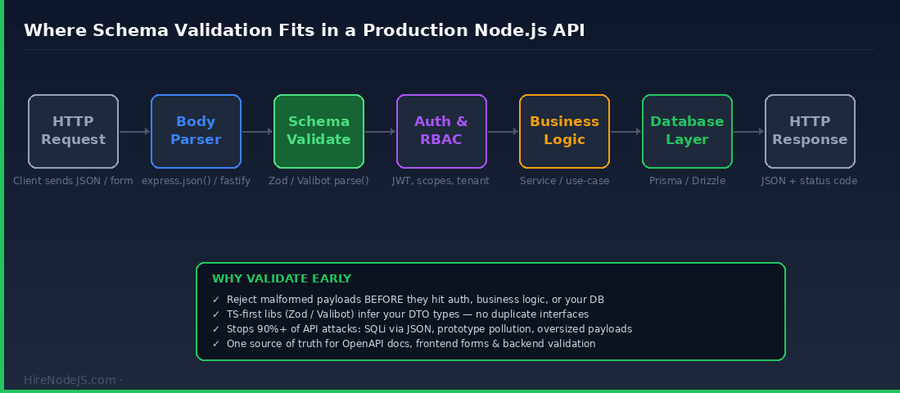
Treating the validator as 'something you add at the end' is the most common production mistake we see in code reviews. Schema validation is the boundary between untrusted input and your business logic — it should run before authentication, before database queries, before any side effect. Done right, it stops malformed payloads, oversized requests, prototype pollution, and most NoSQL injection attacks for free.
What "good" validation looks like in 2026
A modern Node.js validator should: (1) infer your TypeScript types directly from the schema so you never duplicate a DTO interface, (2) compile down to less than 20 kB gzipped to keep cold starts fast on serverless, (3) support both sync and async refinements (database uniqueness checks, remote calls), (4) produce structured error objects you can map to JSON:API or RFC 7807 problem-details responses, and (5) let you compose, extend, and partial-apply schemas without copy-pasting.
The cost of skipping it
OWASP's API Security Top 10 lists 'broken object property level authorization' and 'unsafe consumption of APIs' as two of the top five risks for 2025–2026. Both come down to the same fix: validate every field of every payload, every time. Teams that skip validation end up with JSON parsers that crash on deeply nested objects, NoSQL operators leaking into Mongo queries, and integer fields silently coerced into strings — bugs that take days to track down and minutes to prevent.
Zod: The TypeScript-First Default for Most Node.js Teams
Zod has become the de-facto standard validation library in the TypeScript ecosystem. It defines schemas as values (not classes or decorators), infers types automatically with `z.infer<typeof Schema>`, and integrates with virtually every modern Node.js framework — tRPC, Next.js Server Actions, Hono, Astro, and Fastify all ship first-party Zod adapters.
When Zod wins
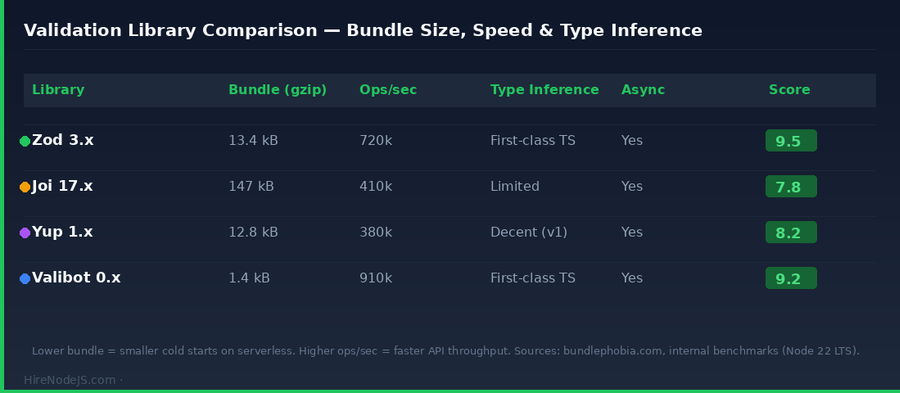
Zod is the right pick when your team already runs strict TypeScript, when you need rich composition (unions, discriminated unions, refinements, transformations), and when you want one schema to drive both runtime parsing and OpenAPI doc generation via packages like `@asteasolutions/zod-to-openapi`. The 13.4 kB gzipped bundle is acceptable for almost any API except heavily code-split frontends.
A realistic Zod schema for a SaaS user signup
import { z } from "zod";

export const SignupSchema = z.object({
  email: z.string().trim().toLowerCase().email("Invalid email"),
  password: z
    .string()
    .min(12, "Password must be at least 12 characters")
    .regex(/[A-Z]/, "Password must contain an uppercase letter")
    .regex(/[0-9]/, "Password must contain a digit"),
  fullName: z.string().min(2).max(80),
  role: z.enum(["owner", "admin", "member"]).default("member"),
  acceptTerms: z.literal(true, {
    errorMap: () => ({ message: "You must accept the terms" }),
  }),
  inviteToken: z.string().uuid().optional(),
});

export type SignupInput = z.infer<typeof SignupSchema>;

// In an Express handler:
app.post("/api/auth/signup", (req, res) => {
  const result = SignupSchema.safeParse(req.body);
  if (!result.success) {
    return res.status(400).json({
      error: "ValidationError",
      details: result.error.flatten(),
    });
  }
  const data: SignupInput = result.data; // fully typed, sanitized
  // ... pass to your service layer
});
Valibot: The Modular Newcomer Built for Tree-Shaking
Valibot started shipping in 2024 and has quietly become the choice for teams obsessed with bundle size. Instead of one big chainable API, every validator is a tree-shakeable function. A schema with three rules pulls in three functions — total payload often under 1.5 kB gzipped. That difference matters on Lambda, Cloudflare Workers, and Edge Runtimes where every kilobyte adds milliseconds to cold start.
How the API differs from Zod
Where Zod chains methods (`z.string().email().min(5)`), Valibot composes functions (`v.pipe(v.string(), v.email(), v.minLength(5))`). The TypeScript inference is identical in quality — both libraries derive your types from the schema with `v.InferOutput<typeof Schema>`. The trade-off is ecosystem: Zod has hundreds of integrations; Valibot has dozens.
The same signup schema in Valibot
import * as v from "valibot";

export const SignupSchema = v.object({
  email: v.pipe(v.string(), v.trim(), v.toLowerCase(), v.email("Invalid email")),
  password: v.pipe(
    v.string(),
    v.minLength(12, "At least 12 characters"),
    v.regex(/[A-Z]/, "Must include an uppercase letter"),
    v.regex(/[0-9]/, "Must include a digit"),
  ),
  fullName: v.pipe(v.string(), v.minLength(2), v.maxLength(80)),
  role: v.optional(v.picklist(["owner", "admin", "member"]), "member"),
  acceptTerms: v.literal(true),
  inviteToken: v.optional(v.pipe(v.string(), v.uuid())),
});

export type SignupInput = v.InferOutput<typeof SignupSchema>;

// In a Hono handler running on Cloudflare Workers:
app.post("/auth/signup", async (c) => {
  const body = await c.req.json();
  const result = v.safeParse(SignupSchema, body);
  if (!result.success) {
    return c.json({ error: "ValidationError", issues: result.issues }, 400);
  }
  const data: SignupInput = result.output;
  return c.json({ ok: true, user: data });
});
Joi: The Mature, JavaScript-First Veteran
Joi was built by the Hapi team in 2014 and remains the most battle-tested validation library in the Node.js world. If your team writes mostly plain JavaScript or your codebase predates the TypeScript-first wave, Joi's documentation, error messages, and rule library are unmatched. The 147 kB gzipped weight, however, makes it a poor fit for any serverless or edge deployment.
Hire Pre-Vetted Node.js Developers
Skip the months-long search. Our exclusive talent network has senior Node.js experts ready to join your team in 48 hours.
Why Joi still ships in production
Joi's `Joi.string().email().required()` API reads almost like English, and its `validateAsync` method has clean async support that predates most competitors. It produces some of the most actionable error messages of any validator — multilingual, with paths, types, and contexts ready for direct UI mapping. For internal tools, admin dashboards, and long-running services where bundle size doesn't matter, Joi remains a perfectly defensible choice.
Yup: The React Hook Form Companion
Yup occupies a specific niche: form validation in React apps with Formik or React Hook Form. Both libraries shipped Yup adapters years before Zod existed, and many existing codebases still use it. The version 1.x release in 2023 added much better TypeScript inference and dropped the legacy chainable-only API for a more modular approach.
Backend use cases where Yup still makes sense
If you already have shared schemas powering your React forms with Yup, reusing those exact schemas in your Node.js API removes drift between client and server validation. That's the strongest argument for Yup on the backend in 2026 — not standalone superiority, but symmetry with an existing frontend setup.
Picking Between Them: A Practical Decision Tree
Most production Node.js teams should default to Zod — it's the safest, best-supported, most TypeScript-native choice. Pick Valibot when you ship to Cloudflare Workers, Lambda, or Edge runtimes and bundle size genuinely matters. Pick Joi when you're maintaining a mature JavaScript codebase or need the richest async-rule library out of the box. Pick Yup only when frontend symmetry justifies it.
Async refinements: a real-world example
Most validation work is synchronous, but signup flows often need to check uniqueness against a database — an asynchronous operation that depends on the validator's `parseAsync` (Zod), `safeParseAsync` (Valibot), or `validateAsync` (Joi). Here's the pattern with Zod:
import { z } from "zod";
import { db } from "../db";

const UniqueEmailSchema = z.object({
  email: z.string().email().refine(
    async (email) => {
      const existing = await db.user.findUnique({ where: { email } });
      return !existing;
    },
    { message: "An account with that email already exists" }
  ),
  password: z.string().min(12),
});

// usage:
app.post("/auth/signup", async (req, res) => {
  const result = await UniqueEmailSchema.safeParseAsync(req.body);
  if (!result.success) {
    return res.status(409).json({ error: result.error.flatten() });
  }
  // ... create user
});
Performance, Deployment, and Cold-Start Reality
Raw ops/sec numbers (see Figure 2 above) are misleading without context. For a typical API doing 1–5 ms of database work per request, even Yup's 380 k ops/sec means validation costs less than 0.003 ms per request — utterly negligible. The real production differentiator is bundle size on serverless functions, where cold starts can add 200–800 ms to a single user-visible request.
Bundle math on AWS Lambda Node 22
A bare-bones Lambda function imports your handler, your validator, your ORM, and your business code. With Joi (147 kB), the cold-start penalty alone can be 60–120 ms. With Valibot (1.4 kB), it's negligible. For high-traffic, latency-sensitive APIs deployed at the edge, that single decision is worth more than every other micro-optimization combined.
Hire Expert Node.js Developers — Ready in 48 Hours
Building production-grade APIs is only half the battle — you need engineers who know how to wire validation, auth, and observability together cleanly. HireNodeJS.com specialises exclusively in Node.js talent: every developer is pre-vetted on real-world projects, schema design, API security, and production deployments on AWS, Cloudflare, and Vercel.
Unlike generalist platforms, our curated pool means you speak only to engineers who live and breathe Node.js. Most clients have their first developer working within 48 hours of getting in touch. Engagements start as short-term contracts and can convert to full-time hires with zero placement fee.
If your team needs a backend specialist who can ship a TypeScript-first API on day one, browse our backend developer profiles — every engineer has shipped Zod, Prisma, and one of Express, Fastify, or NestJS in production.
Summary: What to Pick in 2026
Zod is the safe default for any TypeScript-first Node.js team in 2026 — it has the deepest ecosystem, the cleanest type inference, and is good enough on bundle size for most applications. Valibot is the right choice when you ship to serverless or edge runtimes and bundle size meaningfully impacts cold starts. Joi remains a strong pick for plain-JavaScript codebases and async-heavy validation. Yup makes sense primarily when you already share schemas with a React frontend that uses it.
Whatever you choose, the most important rule stays the same: validate every payload at the edge of your API, before any business logic or database access. The library matters less than the discipline of using it consistently across every endpoint, every queue consumer, and every webhook handler in your stack.
Frequently Asked Questions
Which Node.js validation library should I use in 2026?
For most TypeScript-first teams, Zod is the safest default — it has the largest ecosystem, the cleanest type inference, and works with virtually every modern Node.js framework. Pick Valibot if your service runs on Cloudflare Workers, Lambda, or another edge runtime where bundle size matters.
Is Valibot a real replacement for Zod?
Valibot offers nearly identical functionality and TypeScript inference quality with a fraction of the bundle size (around 1.4 kB versus 13.4 kB). The trade-offs are smaller ecosystem and fewer first-party framework adapters. For greenfield serverless projects, Valibot is a strong choice; for established TypeScript codebases, Zod is still the safer bet.
Should I still use Joi in 2026?
Yes, if your codebase is mostly plain JavaScript or you need the richest async-rule library out of the box. Joi is mature, battle-tested, and produces some of the best error messages in the ecosystem. Avoid it for serverless or strict TypeScript projects where its 147 kB bundle and limited type inference become real problems.
Where should validation happen in a Node.js API request?
Schema validation should run immediately after the body parser and before authentication, business logic, or any database query. Validating at the edge of your API stops malformed payloads, prototype pollution, and most NoSQL injection patterns before they touch the rest of your stack.
Does validation library choice affect API performance?
Marginally for raw throughput — even the slowest library validates a typical payload in under 0.01 ms. Where it matters is bundle size on serverless deployments: a heavier library can add 60–120 ms to a Lambda cold start, which is far more user-visible than per-request validation cost.
Can I share a single schema between my Node.js backend and React frontend?
Yes. All four libraries (Zod, Valibot, Joi, Yup) work in both Node.js and the browser. Sharing schemas via a monorepo package keeps client and server validation in sync and gives you a single source of truth for form state, API contracts, and TypeScript types.
Vivek Singh is the founder of Witarist and HireNodeJS.com — a platform connecting companies with pre-vetted Node.js developers. With years of experience scaling engineering teams, Vivek shares insights on hiring, tech talent, and building with Node.js.
Need a Node.js Engineer Who Builds Type-Safe APIs?
HireNodeJS connects you with pre-vetted senior Node.js engineers who ship validation-first, TypeScript-strict APIs in production. First developer in 48 hours, no recruiter fees.