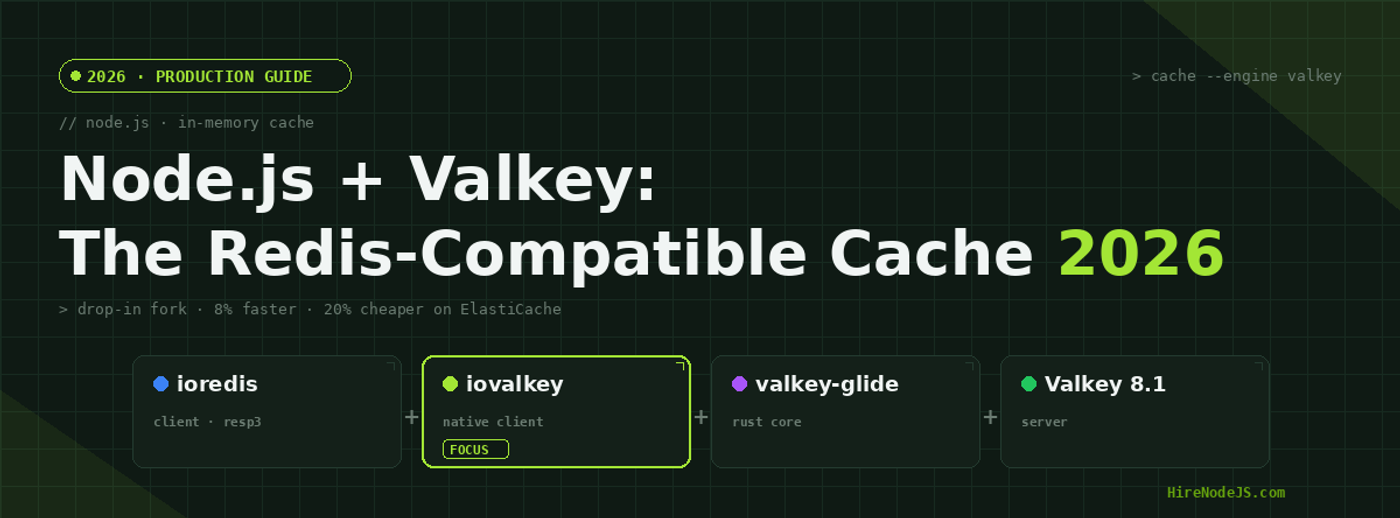
Node.js + Valkey in 2026: The Redis-Compatible Cache
Redis was the default in-memory cache for Node.js teams for over a decade. Then, in March 2024, Redis Inc. relicensed the project away from open source, and within a week the Linux Foundation launched Valkey — a community-governed fork backed by AWS, Google Cloud, Oracle, and the original Redis maintainers. Two years on, Valkey is not a hedge or a curiosity. It is the version of Redis that most cloud providers now ship by default, and for many Node.js workloads it is measurably faster and cheaper.
This guide covers what Valkey actually is in 2026, how its performance compares to Redis OSS on real benchmarks, how to wire it into a Node.js service, and the cache-aside and write patterns that keep production systems fast without serving stale data. Because Valkey is protocol-compatible, almost everything you already know about Redis still applies — but the licensing, pricing, and roadmap have changed enough that the decision is worth revisiting.
What Valkey Is and Why It Exists
Valkey is a high-performance, in-memory key-value store forked from Redis 7.2.4 at the moment Redis moved to the dual SSPLv1/RSALv2 license. It is governed by the Linux Foundation, ships under the permissive BSD-3-Clause license, and is maintained by many of the engineers who built Redis in the first place. The fork was not a protest gesture — it was an insurance policy that the largest cloud vendors immediately adopted, which is why Valkey now has more committed engineering resources than at almost any point in Redis's open-source history.
Drop-in compatibility by design
Valkey speaks the exact same RESP2 and RESP3 wire protocol as Redis. Every command, data structure, and persistence option you rely on — strings, hashes, sorted sets, streams, RDB snapshots, AOF — behaves identically. That compatibility is the whole point: an application using Redis with Node.js can migrate to Valkey by changing a connection string and nothing else.
What changed after the fork
The two projects have diverged in emphasis. Redis Inc. is folding its commercial modules — RediSearch, RedisJSON, RedisBloom, vector search — into the core distribution to make the licensed product more attractive. Valkey has stayed focused on the engine itself: multi-threaded I/O, lower memory overhead per key, faster cluster failover, and async replication improvements. For a typical Node.js caching or session-store workload, the engine work is exactly what moves the needle.
Valkey vs Redis: Performance in 2026
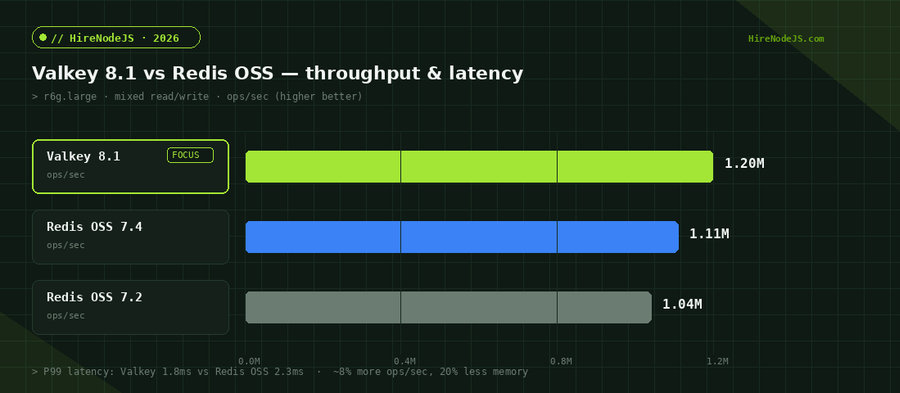
Valkey 8.1, released March 31, 2025, is the version most managed services now run. On an r6g.large node with mixed read/write traffic it sustains about 1.2 million operations per second versus 1.11 million for Redis OSS — close to an 8% throughput gain. P99 tail latency drops from 2.3 ms to 1.8 ms, and steady-state memory use falls roughly 20% thanks to per-key overhead reductions. On AWS ElastiCache, Valkey nodes are also priced about 20% lower per hour than the Redis-branded equivalents, so the saving is both in capacity and in the bill.
Where the gains come from
Most of the throughput improvement comes from expanded multi-threaded I/O: Valkey offloads more of the socket read, command parsing, and reply construction work onto dedicated I/O threads, leaving the main thread free to execute commands. For Node.js services that fan out hundreds of concurrent cache reads per request, that translates directly into flatter tail latency under load.
Do client libraries matter?
Benchmarks of the popular Node.js clients — ioredis, the official redis package, and valkey-glide — show they perform within noise of each other for sequential operations. The redis package edges ahead on highly concurrent pipelines, and valkey-glide's Rust core shines under heavy multiplexing, but for typical web workloads you should choose on API ergonomics, not micro-benchmarks. All three connect to Valkey without code changes.
Connecting Node.js to Valkey
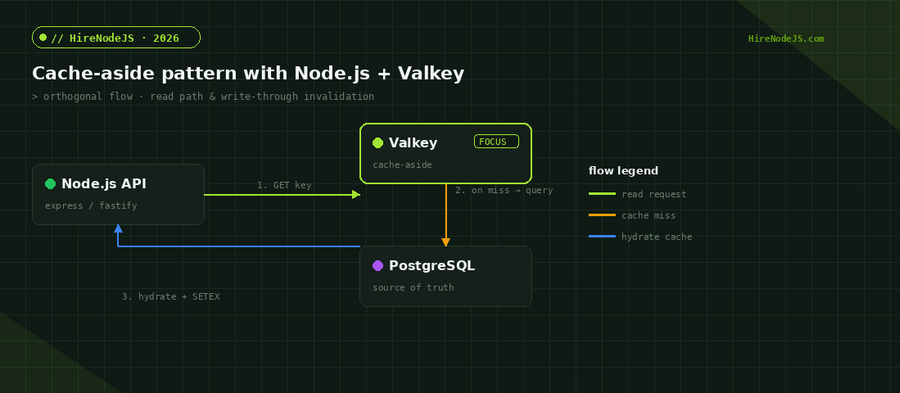
Wiring Valkey into a Node.js backend looks identical to a Redis integration because the client libraries are the same. The example below uses iovalkey — a maintained fork of ioredis pinned to the Valkey protocol — but ioredis or the official redis client would work line-for-line. The pattern shown is cache-aside: read from the cache, fall back to the database on a miss, then hydrate the cache with a TTL so stale entries expire on their own.
A minimal cache-aside service
import { createClient } from 'iovalkey';

// Valkey speaks the Redis protocol, so existing clients connect unchanged.
const valkey = createClient({
  socket: { host: process.env.VALKEY_HOST, port: 6379, tls: true },
  password: process.env.VALKEY_PASSWORD,
});

valkey.on('error', (err) => console.error('valkey error', err));
await valkey.connect();

// Cache-aside read: try the cache first, fall back to Postgres, then hydrate.
export async function getUser(id) {
  const cacheKey = `user:${id}`;
  const cached = await valkey.get(cacheKey);
  if (cached) return JSON.parse(cached);

  const user = await db.query('SELECT * FROM users WHERE id = $1', [id]);
  if (user) {
    // SET with a 5-minute TTL so stale data self-expires.
    await valkey.set(cacheKey, JSON.stringify(user), { EX: 300 });
  }
  return user;
}

// Write-through invalidation: drop the key whenever the row changes.
export async function updateUser(id, patch) {
  const user = await db.update('users', id, patch);
  await valkey.del(`user:${id}`);
  return user;
}
The two operations that matter most are the TTL on every write and the explicit invalidation on every update. The TTL bounds how stale any cached value can become even if you forget to invalidate it; the invalidation keeps hot keys correct immediately after a write. Skipping either one is the most common source of cache bugs in production Node.js services.
Hire Pre-Vetted Node.js Developers
Skip the months-long search. Our exclusive talent network has senior Node.js experts ready to join your team in 48 hours.
Cache-Aside, Write-Through, and Invalidation Patterns
Cache-aside is the right default for most Node.js APIs, but it is not the only pattern. Write-through caching updates the cache and the database in the same operation, trading a little write latency for guaranteed read freshness. Write-behind buffers writes in the cache and flushes them to the database asynchronously, which is fast but risks data loss on a crash. Choosing between them is a function of how tolerant your domain is of momentary staleness.
Avoiding the thundering herd
When a popular key expires, every concurrent request misses at once and stampedes PostgreSQL simultaneously. Guard against it with a short lock — a SET NX on a lock key — so only one request rebuilds the value while the others wait briefly and read the freshly hydrated entry. Valkey's low latency makes this lock cheap enough to apply on every hot key.
TTL strategy under real traffic
A single global TTL is rarely optimal. Add a small random jitter to each expiry so keys created in the same burst do not all expire on the same second, and use longer TTLs for slowly changing reference data than for user-specific records. The interactive chart below shows why tail latency matters: as concurrency climbs, Valkey's P99 stays flatter than Redis OSS, which is exactly the regime where a cache stampede would otherwise hurt most.
Running Valkey in Production: Clustering, Persistence, and TLS
A cache that falls over under load is worse than no cache, because your database is now sized assuming the cache absorbs most reads. Production Valkey deployments lean on the same primitives as Redis: cluster mode for horizontal sharding, replicas for read scaling and failover, AOF or RDB persistence depending on durability needs, and TLS plus AUTH on every connection. Managed services like ElastiCache and MemoryDB handle most of this, but the configuration decisions are still yours.
Cluster mode and failover
In cluster mode Valkey shards keys across primaries using hash slots, with replicas promoted automatically on primary failure. Valkey 8.x improved failover speed and replication throughput, which shortens the window where reads briefly miss during a node loss. For Node.js clients, enable cluster awareness so the driver follows MOVED and ASK redirects instead of erroring.
Migrating from Redis to Valkey
Because the data format and protocol are identical, migration is usually a configuration change rather than a code change. On managed platforms you can often perform an in-place engine swap; self-hosted, you replicate from the Redis primary into a Valkey replica and then promote it. Most teams pair the migration with a review of their DevOps and infrastructure tooling, since it is a natural moment to tighten TLS, rotate credentials, and revisit cluster sizing.
A safe rollout checklist
Validate client compatibility in staging, snapshot the Redis dataset, stand up Valkey as a replica, verify key counts and a sample of values match, then cut traffic over behind a feature flag so you can roll back instantly. Because both speak the same protocol, the rollback path is symmetrical — point the connection string back at Redis if anything looks wrong.
Caching is one of those areas where a small architectural mistake — a missing TTL, an unguarded stampede, a cluster sized for the wrong read pattern — quietly costs real money and reliability. If you are standing up or migrating a caching layer and want it done right the first time, HireNodeJS connects you with pre-vetted senior Node.js engineers who have run Valkey and Redis at scale, available within 48 hours and without the recruiter overhead.
Hire Expert Node.js Developers — Ready in 48 Hours
Choosing Valkey is the easy part — building a caching layer that stays fast and correct under production load is where experience pays off. HireNodeJS.com specialises exclusively in Node.js talent: every developer is pre-vetted on real-world projects, API design, event-driven architecture, and production deployments.
Unlike generalist platforms, our curated pool means you speak only to engineers who live and breathe Node.js. Most clients have their first developer working within 48 hours of getting in touch. Engagements start as short-term contracts and can convert to full-time hires with zero placement fee.
Conclusion
Valkey has gone from a defensive fork to the de facto open-source Redis in just two years. For Node.js teams the upside is concrete: about 8% more throughput, roughly 20% less memory, lower managed-service pricing, and a permissive license backed by the major cloud vendors — all while keeping the protocol, clients, and mental model you already use. The migration risk is low precisely because almost nothing about your code has to change.
If you are starting a new service in 2026, default to Valkey and use the cache-aside patterns above with sensible TTLs and stampede protection. If you are running Redis OSS today, plan a staged migration — the performance and cost gains are real, and the path back is always one connection string away.
Frequently Asked Questions
Is Valkey a drop-in replacement for Redis?
Yes. Valkey was forked from Redis 7.2.4 and keeps the exact same RESP protocol, commands, and data structures. Existing Node.js clients like ioredis and the official redis package connect to Valkey without any code changes.
Is Valkey faster than Redis in 2026?
On comparable hardware, Valkey 8.1 sustains roughly 8% more operations per second than Redis OSS, with about 22% lower P99 latency and 20% less memory use, largely due to expanded multi-threaded I/O.
Why was Valkey created?
When Redis Inc. relicensed Redis away from open source in March 2024, the Linux Foundation launched Valkey as a community-governed, BSD-licensed fork backed by AWS, Google Cloud, Oracle, and former Redis maintainers.
Which Node.js client should I use with Valkey?
ioredis, the official redis package, and valkey-glide all work and perform within noise of each other for typical workloads. Choose based on API preference; iovalkey is a maintained fork tuned for Valkey.
How hard is it to migrate from Redis to Valkey?
For most teams it is a configuration change rather than a code change. You can replicate from a Redis primary into a Valkey replica, verify the data, and cut over behind a feature flag with an instant rollback path.
Is Valkey cheaper than Redis on AWS?
Yes. On AWS ElastiCache, Valkey nodes are priced roughly 20% lower per hour than the Redis-branded equivalents, and the lower memory footprint can reduce required capacity as well.
Vivek Singh is the founder of Witarist and HireNodeJS.com — a platform connecting companies with pre-vetted Node.js developers. With years of experience scaling engineering teams, Vivek shares insights on hiring, tech talent, and building with Node.js.
Need a Node.js engineer who knows caching at scale?
HireNodeJS connects you with pre-vetted senior Node.js engineers experienced with Valkey, Redis, and high-throughput backends — available within 48 hours. No recruiter fees, no lengthy screening, just talent ready to ship.