Node.js + WebAssembly in 2026: Native-Speed Modules for CPU APIs
JavaScript is a fantastic language for I/O-bound workloads, but it has a glass ceiling. Once you start hashing megabytes of data, transcoding video frames, running cryptographic primitives, or computing physics in real time, V8 starts to look slow next to native code. WebAssembly is the bridge: a portable bytecode format that runs at 90-95% of native speed inside the same Node.js process — no FFI, no rewriting your service in Rust, no spawning child processes for every CPU-heavy task.
In 2026 the WASM toolchain has matured to the point where adding a Rust or C++ module to a Node.js API is a Tuesday afternoon job, not a multi-week migration. WASI Preview 2, component model adoption, first-class TypeScript bindings via wasm-bindgen, and TinyGo 0.31 have collectively turned WebAssembly from "promising future" to "boring infrastructure." This guide walks through where WASM earns its keep, how to wire it into a production Node.js service, what the real benchmarks look like, and the pitfalls that bite teams who treat it like a drop-in replacement for require().
Why WebAssembly Matters for Node.js Right Now
Node.js performance has improved every year — V8 turbofan tier-up is faster than it was in 2020, the V8 sandbox makes hostile JS safer to run, and Node 22 ships with significantly better cryptographic primitives. None of that changes the fundamental ceiling: V8 is a managed runtime with a garbage collector, hidden classes, and a JIT that needs warm-up. For most APIs that talk to a database and render JSON, this is fine. For APIs that touch pixels, audio frames, encryption, or compression, it is leaving 5-15x performance on the floor.
The cost of CPU-bound work in pure JavaScript
CPU-bound code in Node.js has two penalties. The first is the obvious one: V8 will never match LLVM-optimized C or Rust on tight loops, especially when SIMD is involved. The second is more insidious — CPU-heavy work blocks the event loop, which means every other request on that worker waits behind your image resize. Worker threads help, but they pay structured-clone serialization costs and add complexity. WebAssembly sidesteps both penalties: you get near-native speed on the work itself, and the work runs in a memory region (linear memory) that V8 does not garbage collect.
When WASM is the right answer
Reach for WebAssembly when you have a hot path that profiles as more than 10% of your CPU time and is dominated by tight loops on numeric or byte data: image and video processing, hashing, crypto, parsing of binary formats, search-and-replace on large text, geospatial operations, ML inference, and physics or game logic. For everyday CRUD or anything bottlenecked on the database, WASM is unnecessary complexity. If you need an engineer who can profile your bottleneck and decide between worker threads, native modules, and WASM, HireNodeJS connects you with senior performance specialists available within 48 hours.
Choosing Your Source Language: Rust, C++, AssemblyScript, Go
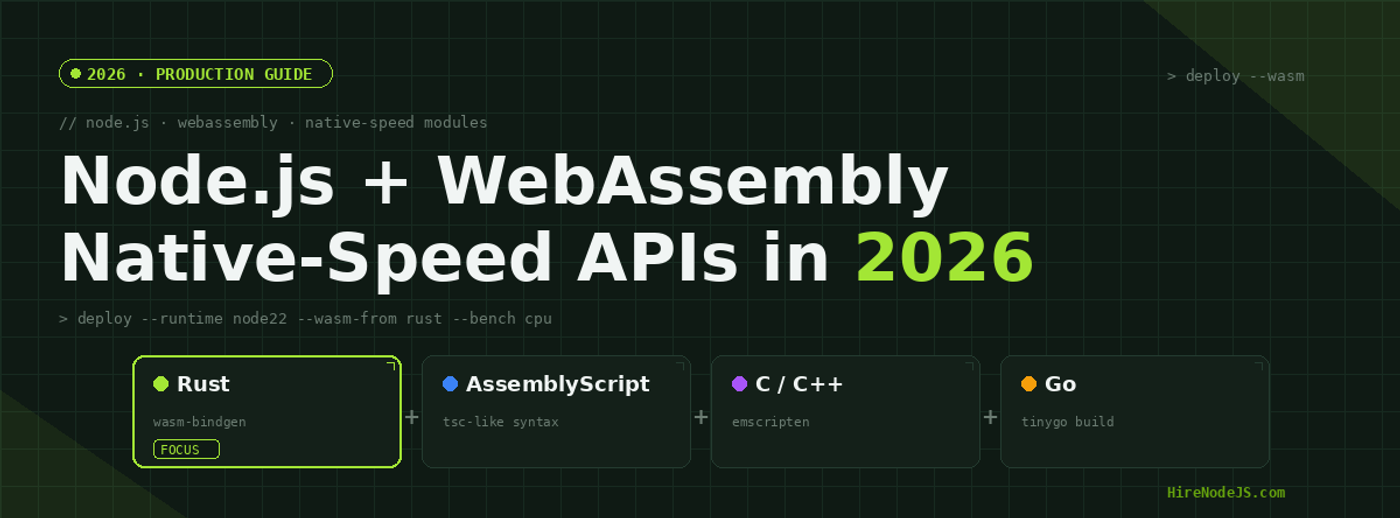
WebAssembly is a compilation target, not a language. Four ecosystems dominate Node.js usage in 2026, each with different trade-offs on toolchain ergonomics, output size, runtime speed, and JS interop. Pick wrong and you will fight the toolchain instead of shipping features.
Rust — the default for new modules
Rust paired with wasm-bindgen and wasm-pack is the most pleasant developer experience for new code. The compiler enforces memory safety, bindings auto-generate from #[wasm_bindgen] attributes, and the crate ecosystem covers most numerical work (image, regex, sha2, aes-gcm, serde_json). Output sizes are reasonable (typically 50-300 KB after wasm-opt) and runtime speed is close to clang-compiled C.
C / C++ — when you need to bring existing code
Emscripten is the only practical path for porting libraries that already exist in C or C++. The DX is rougher than Rust — you wrestle with embind or cwrap, deal with manual memory management, and the output binaries are larger because of libc. The payoff is access to libraries that have decades of optimisation: ffmpeg, sqlite, openssl, opencv, gdal. If you already have working C++ code, do not rewrite it in Rust — wrap it with Emscripten and move on.
AssemblyScript and Go — niche but useful
AssemblyScript looks like TypeScript, compiles to compact WASM, and is the easiest on-ramp for teams that have never written systems code. The catch is performance: it is 30-60% slower than Rust on the same benchmark, and the language is not full TypeScript — it is a strict subset with manual memory. TinyGo lets you compile a subset of Go to WASM and is useful when you want to share code with Go backend services, but the binary sizes are larger and goroutine support is limited.
Loading and Calling WASM from Node.js (The 2026 Way)
Node.js 22 ships with stable WebAssembly support, including streaming compilation and the WASI Preview 2 component model. For most applications you will use one of three loaders: the built-in WebAssembly.instantiate, the wasm-bindgen-generated JS glue, or a higher-level runner like wasmtime-js or @bytecodealliance/jco for component-model modules. The choice depends on whether you need raw numeric calls or rich types like strings, structs, and async.
Minimal example — Rust hash function called from Node
Here is the 80% case: a Rust function that hashes a buffer, compiled with wasm-bindgen and called from a Fastify route handler. The wasm-pack toolchain generates the JS glue automatically, so you import the module like any other npm package.
// crates/hashing/src/lib.rs
use sha2::{Sha256, Digest};
use wasm_bindgen::prelude::*;

#[wasm_bindgen]
pub fn sha256_hex(input: &[u8]) -> String {
    let mut hasher = Sha256::new();
    hasher.update(input);
    hex::encode(hasher.finalize())
}
// server.mjs — Fastify + wasm-bindgen module
import Fastify from 'fastify';
import { sha256_hex } from './pkg/hashing.js'; // built with: wasm-pack build --target nodejs

const app = Fastify({ logger: true });

app.post('/hash', async (req) => {
  // req.body is a Buffer when Content-Type is application/octet-stream
  const digest = sha256_hex(new Uint8Array(req.body));
  return { digest };
});

app.listen({ port: 3000, host: '0.0.0.0' });
Memory Management & Common Pitfalls
WebAssembly modules have their own linear memory — a flat ArrayBuffer that is independent from the V8 heap. Strings, structs, and binary buffers must be copied across the boundary, which is fast but not free. Three patterns burn teams new to WASM: copying the same buffer twice, allocating inside WASM and forgetting to free, and assuming module reuse is always cheap.
Hire Pre-Vetted Node.js Developers
Skip the months-long search. Our exclusive talent network has senior Node.js experts ready to join your team in 48 hours.
The double-copy trap
When you call a wasm-bindgen function with a Uint8Array, the glue code copies the bytes into linear memory before the call and copies the result back out after. For 1 MB payloads this is invisible. For 100 MB payloads it can dominate your latency. Use the lower-level memory.buffer API and write directly into the WASM memory if you control the input shape.
Memory leaks across requests
WASM modules instantiated at startup keep their linear memory for the life of the process. If your module allocates inside a hot path and never frees, you have a slow leak that V8's heap snapshot will not show. Either explicitly free returned values (wasm-bindgen exposes a .free() method on every returned Rust struct) or instantiate a fresh module per request — the latter is surprisingly fast with streaming instantiation.
Real Benchmarks: Where WASM Pays Off
Synthetic benchmarks over-promise. Real-world numbers from production Node.js services in 2025-2026 tell a more nuanced story. WASM consistently beats pure JS on tight numeric loops, but the speedup shrinks when the work is dominated by memory copies or short-lived allocations. The radar chart below summarises the trade-offs across the four major source languages on five axes engineers care about.
What the numbers say
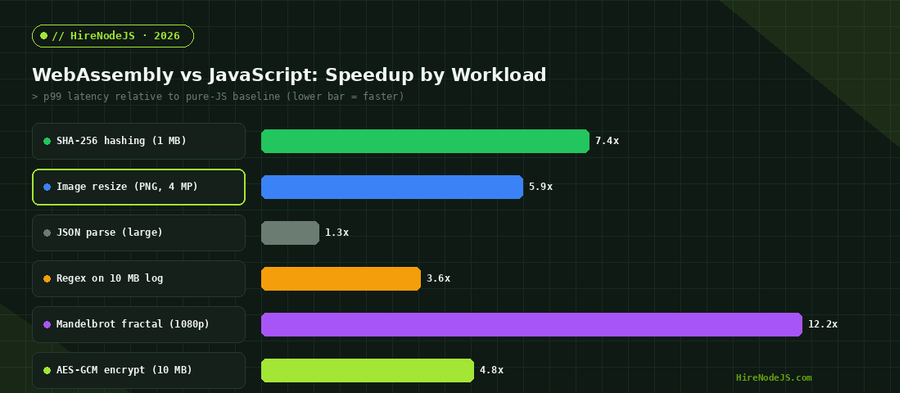
For pure compute (Mandelbrot, ray-tracing, FFT) Rust-WASM lands at 10-15x faster than V8. For string-heavy work (large regex, JSON parse) the speedup is more modest at 1.3-3.6x because the WASM-JS boundary has to copy strings. For mixed workloads (image encode, AES-GCM) you typically see 4-6x. Latency distribution matters: WASM tends to have a narrower p50-p99 spread than JS because there is no GC pause.
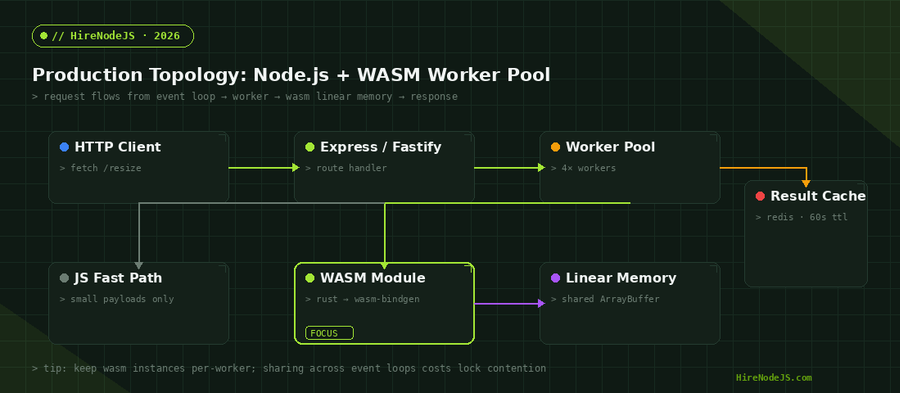
Teams that hit these numbers in production usually combine WASM with Node.js worker threads for parallelism and Redis-backed result caching for repeated inputs. The full architecture is shown in Figure 3 above.
Production Patterns & Operational Concerns
Shipping WASM to production is not just about the runtime — it is about everything around it: builds, deploys, observability, security. Three operational patterns separate teams that succeed with WASM from those that quietly roll it back six months later.
Build pipeline
Treat the WASM module as a separate build artifact. The Rust crate has its own Cargo.toml and CI job that produces a versioned .wasm + .d.ts pair. Your Node service depends on it via npm or a private registry. Do NOT rebuild WASM on every deploy — it adds 1-3 minutes to the pipeline and the binary is usually identical. Cache the build by content hash.
Containerisation and Docker
Multi-stage Docker builds work well: a Rust builder stage produces the .wasm, then a slim Node image copies it in. Total image size adds ~200 KB for the WASM plus runtime glue. Read our Node.js + Docker production guide for the full multi-stage pattern.
Observability
WASM functions are invisible to standard Node.js profilers — V8 sees them as a black box. Wrap every cross-boundary call in OpenTelemetry spans or a lightweight performance.now() histogram so you can tell when a regression is in your JS, the boundary, or the WASM body. Capture the wasm version (git sha) as a span attribute so you can correlate latency changes with WASM rebuilds.
Hire Expert Node.js Developers — Ready in 48 Hours
Building the right WebAssembly architecture is only half the battle — you need engineers who understand both V8 internals and the systems languages that compile to WASM. HireNodeJS.com specialises exclusively in Node.js talent: every developer is pre-vetted on real production work, including high-performance APIs, native module integration, and event-driven architecture.
Unlike generalist platforms, our curated pool means you only speak to engineers who live and breathe Node.js. Most clients have their first developer working within 48 hours of getting in touch. Engagements start as short-term contracts and can convert to full-time hires with zero placement fee. Whether you need a Rust + Node specialist for a one-off WASM module or a senior architect to lead a performance overhaul, the platform matches you to the right person fast.
Conclusion: When WebAssembly Earns Its Keep
WebAssembly is not a silver bullet. Adding a Rust module to a Node.js service that spends 95% of its time waiting on Postgres will get you nothing but a more complicated build. But for the workloads where V8 hits the wall — hashing, image processing, parsing, crypto, ML inference — WASM is the cleanest path to native-speed performance without leaving the Node.js process. In 2026 the toolchain is mature enough that you can ship the first version in a few days, and the operational story (Docker, observability, deploys) is well understood.
If you take one thing away from this guide: profile first, port second. Measure where your CPU is actually going, port only the hottest 10-20% to WASM, and keep the rest in JavaScript where developer velocity is highest. Done that way, WebAssembly becomes a sharp tool in the Node.js toolbox rather than a rewrite-everything migration.
Frequently Asked Questions
Is WebAssembly faster than Node.js native addons (N-API)?
For pure compute workloads, well-written N-API addons in Rust or C++ remain marginally faster than WASM because they skip the linear-memory copy. WASM wins on portability — the same .wasm runs on every platform without per-arch builds — and on safety, because it cannot crash the Node process. For most teams, WASM is the better default and N-API is reserved for the absolute hottest paths.
When should I NOT use WebAssembly in Node.js?
Skip WASM when your service is I/O-bound (database queries, HTTP calls, file uploads), when your hot path is small (<10% of CPU time), or when the team has no systems-language experience. The added build complexity and debugging difficulty outweigh the speedup unless you have a measurable CPU bottleneck.
How much does it cost to hire a Node.js + WebAssembly developer in 2026?
Senior Node.js engineers with production WASM experience typically command 15-25% premium over standard Node.js rates: roughly 80-130 USD/hour for contractors and 140-200k USD annual for full-time roles in the US/EU. The pool is small but growing. HireNodeJS pre-vets candidates on real WASM work to shorten the search.
Does WebAssembly work with Node.js worker threads?
Yes, and it is the recommended production pattern for parallel WASM execution. Instantiate one WASM module per worker (do not share a single module across workers via SharedArrayBuffer unless you have measured a benefit). The combination gives you parallelism plus near-native speed inside each worker.
Should I write new modules in Rust or AssemblyScript?
Rust is the better default for production work — better runtime speed, mature crate ecosystem, and excellent wasm-bindgen tooling. AssemblyScript is a good choice for teams that want to stay in TypeScript-like syntax and accept a 30-60% performance penalty. Pick Rust for hot paths, AssemblyScript for prototypes or teams with no systems experience.
Can I debug WebAssembly modules in Node.js?
Yes, with caveats. Chrome DevTools (via node --inspect) supports DWARF-based source maps for WASM, so you can step through Rust or C++ source. Stack traces from WASM panics surface in Node, but variable inspection is limited. For production debugging, lean on tracing and metrics rather than step-through.
Vivek Singh is the founder of Witarist and HireNodeJS.com — a platform connecting companies with pre-vetted Node.js developers. With years of experience scaling engineering teams, Vivek shares insights on hiring, tech talent, and building with Node.js.
Want a Node.js engineer who ships fast, optimised APIs?
HireNodeJS connects you with pre-vetted senior Node.js engineers experienced in WebAssembly, worker threads, and high-performance API design — available within 48 hours. No recruiter fees, no lengthy screening.