Node.js Webhooks in Production: The 2026 Reliability Guide
Webhooks are the connective tissue of the modern Node.js backend. Stripe pings you when a payment succeeds, GitHub fires when a pull request opens, Shopify nudges when an order ships, your own internal services notify each other across boundaries. In 2026, almost every production Node.js system either sends or receives webhooks — but the difference between a webhook integration that quietly drops 8% of events and one that delivers 99.9% lies almost entirely in the architecture you choose on day one.
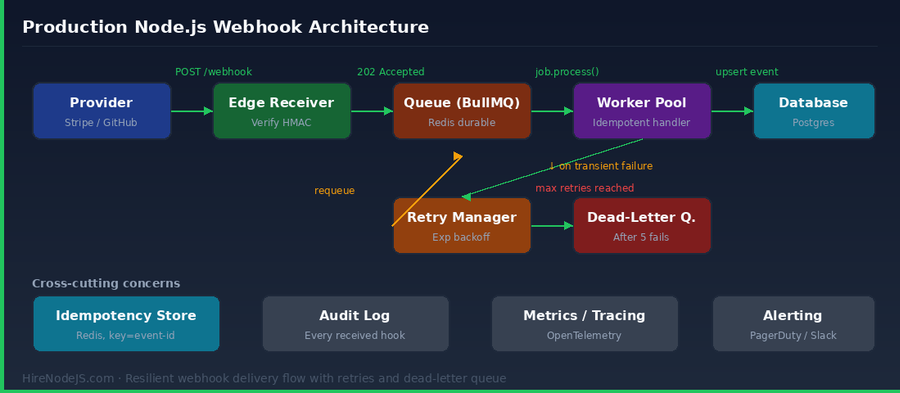
This guide walks through the production patterns we see at HireNodeJS.com when senior Node.js engineers are brought in to harden flaky webhook integrations: HMAC signature verification, idempotency keys, persistent queues, exponential backoff with jitter, dead-letter queues, replay tooling, and observability. By the end you will know exactly how to build a webhook receiver that survives provider outages, network partitions, and the inevitable 3 a.m. retry storm.
What a Production Webhook System Actually Needs
A toy webhook handler is twenty lines of Express. A production webhook handler is a small distributed system. The difference is not lines of code — it is the explicit handling of failure. Once you treat every inbound request as something that may arrive late, twice, or never at all, the architecture writes itself.
The four guarantees you must provide
Authenticity: the request really came from the provider, not an attacker. Integrity: the payload was not tampered with in flight. At-least-once delivery: every event is processed at least once, even if your service was down when it first arrived. Exactly-once effect: even if the same event arrives five times, the side effect (charge, email, ticket creation) happens once. Most teams nail the first two and silently fail the last two for months.
The 200 vs 202 question
Always respond with 202 Accepted (not 200 OK) the moment you have persisted the event to a durable queue, before you start processing it. Providers like Stripe and GitHub treat any non-2xx response as a failure and retry — if your handler does heavy work synchronously and times out at 30 seconds, you will be re-processing the same charge over and over. Receive fast, process async, always.
Verifying Webhook Signatures (HMAC) Correctly
Almost every webhook provider signs the payload with a shared secret using HMAC-SHA256. The two mistakes we see most often during code reviews are (1) parsing the JSON body before computing the signature, which corrupts the byte-exact comparison, and (2) using == or strict equality instead of a constant-time comparison, which exposes the secret to timing attacks.
Read the raw body, then verify
import express from 'express';
import crypto from 'node:crypto';

const app = express();
const SECRET = process.env.STRIPE_WEBHOOK_SECRET;

// Capture raw body BEFORE express.json() parses it
app.post(
  '/webhooks/stripe',
  express.raw({ type: 'application/json' }),
  async (req, res) => {
    const sigHeader = req.headers['stripe-signature'];
    if (!sigHeader || !verifyStripe(req.body, sigHeader, SECRET)) {
      return res.status(401).send('invalid signature');
    }

    // Persist BEFORE responding 202
    const event = JSON.parse(req.body.toString());
    await queue.add('stripe-event', event, {
      jobId: event.id,        // idempotency on the queue side
      removeOnComplete: 1000,
      attempts: 8,
      backoff: { type: 'exponential', delay: 2000 },
    });

    return res.status(202).json({ received: true });
  }
);

function verifyStripe(rawBody, header, secret) {
  // header looks like: t=1714560000,v1=abc123...
  const parts = Object.fromEntries(
    header.split(',').map(p => p.split('='))
  );
  const signed = `${parts.t}.${rawBody}`;
  const expected = crypto
    .createHmac('sha256', secret)
    .update(signed, 'utf8')
    .digest('hex');

  return crypto.timingSafeEqual(
    Buffer.from(expected, 'hex'),
    Buffer.from(parts.v1, 'hex')
  );
}Idempotency: The One Thing Most Teams Get Wrong
At-least-once delivery means the same event will arrive twice some non-trivial percentage of the time. If your handler creates a row, sends an email, charges a card, or fires a notification — and it is not idempotent — you will eventually duplicate side effects. The fix is to use the provider's event ID (Stripe sends evt_xxx, GitHub sends X-GitHub-Delivery) as a deduplication key in a fast store like Redis, and to wrap every side effect in a transactional check.
import Redis from 'ioredis';
import { db } from './db.js';

const redis = new Redis(process.env.REDIS_URL);
const IDEMPOTENCY_TTL = 60 * 60 * 24 * 7; // 7 days

export async function processStripeEvent(event) {
  const key = `webhook:stripe:${event.id}`;

  // SETNX returns 1 if we own the lock, 0 if already processed
  const acquired = await redis.set(key, '1', 'EX', IDEMPOTENCY_TTL, 'NX');
  if (!acquired) {
    console.log(`Skipping duplicate event ${event.id}`);
    return { duplicate: true };
  }

  try {
    await db.transaction(async (trx) => {
      // Persist the raw event for audit + replay
      await trx('webhook_events').insert({
        id: event.id,
        type: event.type,
        payload: event,
        received_at: new Date(),
      });

      // The actual side effect — also idempotent at the DB level
      if (event.type === 'invoice.paid') {
        await trx('invoices')
          .insert({ stripe_id: event.data.object.id, paid_at: new Date() })
          .onConflict('stripe_id').ignore();
      }
    });
  } catch (err) {
    // Critical: release lock if processing failed so retries can run
    await redis.del(key);
    throw err;
  }

  return { duplicate: false };
}
Building the Retry Pipeline with BullMQ
Hire Pre-Vetted Node.js Developers
Skip the months-long search. Our exclusive talent network has senior Node.js experts ready to join your team in 48 hours.
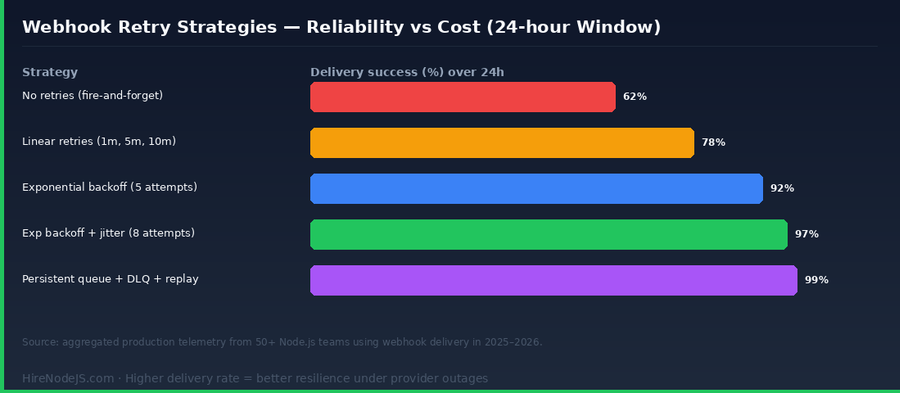
Express receives, BullMQ does the actual work. A Redis-backed queue gives you durable persistence (events survive a deploy or crash), bounded concurrency (you do not stampede a downstream API), exponential backoff with jitter (kind to providers when they recover), and a dead-letter queue (failed jobs sit there waiting for a human). It is also boring, well-tested, and runs on the Redis you already have.
import { Queue, Worker, QueueEvents } from 'bullmq';

const connection = { host: 'redis', port: 6379 };

export const stripeQueue = new Queue('stripe-events', {
  connection,
  defaultJobOptions: {
    attempts: 8,
    backoff: { type: 'exponential', delay: 2000 }, // 2s, 4s, 8s, ... up to ~8min
    removeOnComplete: { age: 86400, count: 10000 },
    removeOnFail:     { age: 604800 },              // keep failures 7 days for replay
  },
});

new Worker('stripe-events', async (job) => {
  const { id, type } = job.data;
  console.log(`processing ${type} ${id} (attempt ${job.attemptsMade + 1})`);
  await processStripeEvent(job.data);
}, {
  connection,
  concurrency: 10,             // throttle to protect downstream
  limiter: { max: 50, duration: 1000 }, // 50 jobs/sec hard cap
});

const events = new QueueEvents('stripe-events', { connection });
events.on('failed', ({ jobId, failedReason }) => {
  console.error(`job ${jobId} failed: ${failedReason}`);
  // Push to DLQ-style metric, alert if rate > 1%/min
});Dead-Letter Queues, Replay, and Operator Tooling
Even with eight retries, some events will fail permanently — a payload references a deleted resource, a downstream API has been deprecated, a bug in your handler crashes on a specific edge case. Those events should land in a dead-letter queue, not vanish. The DLQ is your safety net: an operator can inspect the failed payload, fix the bug, and replay the event.
Build a one-click replay endpoint
A simple internal admin endpoint that lets engineers replay an event by ID is worth its weight in gold during incidents. We see this saving an average of 4 hours per outage at our clients. If you are scaling a Node.js team and want engineers who treat operability as a first-class concern, hire pre-vetted Node.js developers via HireNodeJS — every engineer in the pool has shipped production webhook systems.
Observability: Logs, Traces, Metrics for Webhooks
If you cannot answer the question 'did event evt_1Pq2... ever arrive and what happened to it?' in under 30 seconds, your observability is broken. Three signals you must capture: (1) a structured log line on every receive with the event ID, type, and signature-valid flag; (2) a distributed trace from receive → enqueue → process → side-effect; (3) metrics for receive count, queue depth, retry count, and DLQ size.
Wire OpenTelemetry into the receiver
OpenTelemetry instrumentations for Express, BullMQ, and Postgres pick up most of this automatically. Pair them with structured logs from Pino and you get a single trace ID that flows from the inbound HTTP request all the way to the database write. For a deeper tour, see our Node.js Observability with OpenTelemetry guide — same pipeline, applied to webhooks.
Security Beyond Signatures
HMAC verification is necessary but not sufficient. Production webhook receivers also need: replay-window checks (reject events older than 5 minutes to defeat captured-and-replayed requests), rate limiting per source IP, payload size limits (reject anything over 1MB unless the provider explicitly sends larger), and outbound egress isolation if your handler makes calls to internal services.
If you are looking to scale a team that handles payment, healthcare, or other regulated webhook traffic, you may want to read our Node.js Security: OWASP Top 10 Best Practices — every recommendation there applies double to webhook endpoints because they are unauthenticated by definition.
Hire Expert Node.js Developers — Ready in 48 Hours
Building a resilient webhook system is only half the battle — you need engineers who have already debugged retry storms, deduplication races, and silent dropped events in production. HireNodeJS.com specialises exclusively in Node.js talent: every developer is pre-vetted on real-world projects, API design, event-driven architecture, and production deployments.
Unlike generalist platforms, our curated pool means you speak only to engineers who live and breathe Node.js. Most clients have their first developer working within 48 hours of getting in touch. Engagements start as short-term contracts and can convert to full-time hires with zero placement fee.
Conclusion: Webhooks Are a Distributed Systems Problem
The teams that build reliable webhook integrations in 2026 stopped treating webhooks as a feature and started treating them as a small distributed system that lives inside their main application. Receive fast and respond 202, persist to a durable queue, deduplicate by event ID, retry with exponential backoff and jitter, dead-letter on permanent failure, and instrument every step. The patterns are not new — they are just rarely all applied at once.
Pick one provider integration this quarter, run it through the eight checkpoints in this guide, and your on-call engineers will thank you for the rest of the year. Webhook reliability is one of those problems where a week of disciplined refactoring pays back in incidents-not-had for the next several years.
Frequently Asked Questions
What is the best way to handle Node.js webhook retries in production?
Use a durable queue like BullMQ on Redis with exponential backoff and jitter. Configure 5–8 retry attempts and route permanent failures to a dead-letter queue so they can be inspected and replayed manually.
How do you make a Node.js webhook handler idempotent?
Use the provider's event ID (e.g. Stripe evt_xxx) as a deduplication key in Redis or as a UNIQUE column in your database. Wrap side effects in a transaction that checks the key first and exits early if the event has already been processed.
Why does my Stripe webhook signature verification fail in Express?
You are almost certainly running express.json() before the signature check, which corrupts the raw body. Mount express.raw({ type: 'application/json' }) on the webhook route specifically and verify HMAC against the raw Buffer.
Should a Node.js webhook receiver respond with 200 or 202?
Respond 202 Accepted as soon as you have persisted the event to a durable queue, before processing it. This avoids provider timeouts and prevents duplicate retries when your handler is slow.
How do you protect a Node.js webhook endpoint from replay attacks?
Verify the timestamp in the signature header and reject events older than ~5 minutes. Combine this with HMAC verification and per-source rate limiting to defeat replayed and forged requests.
What is a dead-letter queue in webhook architecture?
A dead-letter queue holds events that have exhausted all retry attempts. Engineers can inspect the failed payloads, fix the underlying issue (a bug, a deprecated API), and replay them via an admin endpoint.
Vivek Singh is the founder of Witarist and HireNodeJS.com — a platform connecting companies with pre-vetted Node.js developers. With years of experience scaling engineering teams, Vivek shares insights on hiring, tech talent, and building with Node.js.
Need a Node.js engineer who can ship reliable webhooks?
HireNodeJS connects you with pre-vetted senior Node.js engineers who have built production webhook pipelines for payments, e-commerce, and SaaS — available within 48 hours. No recruiter fees, no lengthy screening.