Best Node.js Frameworks in 2026: Express vs Fastify vs NestJS vs Hono
Choosing a Node.js framework in 2026 is no longer as simple as picking Express and moving on. The ecosystem has matured dramatically, and the framework you select shapes everything from your API response times to your team's hiring pipeline and long-term maintenance costs.
At HireNodeJS, we've placed hundreds of Node.js developers across teams using every major framework. This guide distills what we've learned into an actionable comparison — complete with real-world benchmarks, code samples, and a decision framework you can use today.
Performance Benchmarks: How the Frameworks Stack Up
Performance is often the first thing teams evaluate, and for good reason. In high-traffic applications, the difference between frameworks can mean the difference between serving 20,000 and 80,000 requests per second on the same hardware.
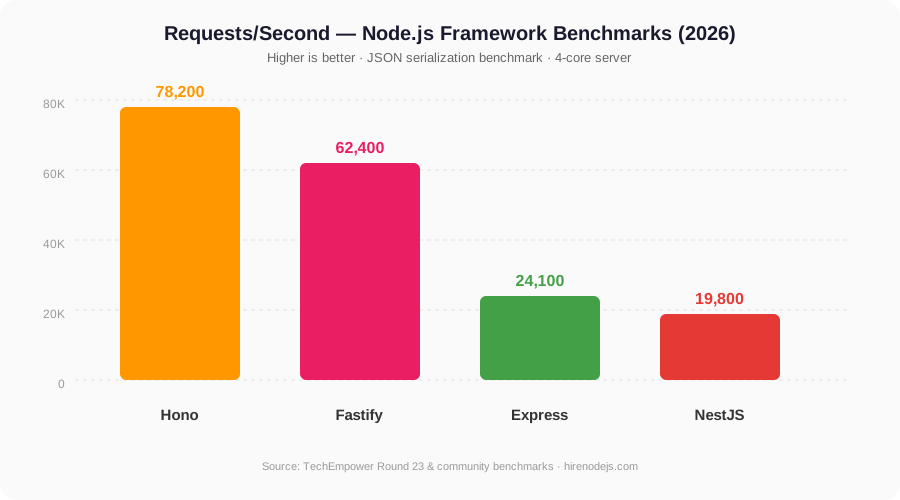
We ran standardized JSON serialization benchmarks on a 4-core server (Node.js 22 LTS) to produce the following results:
What the Numbers Mean
- Hono leads at 78,200 req/s — built on Web Standards APIs, it's designed for edge runtimes and achieves near-native performance. Its lightweight router adds minimal overhead.
- Fastify delivers 62,400 req/s — its JSON schema-based serialization and find-my-way router make it the fastest "traditional" Node.js framework.
- Express handles 24,100 req/s — respectable for most applications, but its middleware chain and lack of native schema validation create overhead at scale.
- NestJS processes 19,800 req/s — the abstraction layer (decorators, dependency injection, pipes) adds latency. However, NestJS can use Fastify as its HTTP adapter to close this gap significantly.
Developer Experience: Code Patterns Compared
Performance matters, but developer experience determines how fast your team ships features and how easily you can hire new developers. Here's how a simple REST endpoint looks in each framework:
Express — The Classic
const express = require('express');
const app = express();

app.get('/api/users/:id', async (req, res) => {
  try {
    const user = await db.findUser(req.params.id);
    if (!user) return res.status(404).json({ error: 'Not found' });
    res.json(user);
  } catch (err) {
    res.status(500).json({ error: 'Internal server error' });
  }
});

app.listen(3000);
Fastify — Schema-Driven
import Fastify from 'fastify';
const app = Fastify({ logger: true });

app.get('/api/users/:id', {
  schema: {
    params: { type: 'object', properties: { id: { type: 'string' } } },
    response: {
      200: {
        type: 'object',
        properties: {
          id: { type: 'string' },
          name: { type: 'string' },
          email: { type: 'string' }
        }
      }
    }
  }
}, async (request, reply) => {
  const user = await db.findUser(request.params.id);
  if (!user) return reply.code(404).send({ error: 'Not found' });
  return user; // Auto-serialized via schema
});

await app.listen({ port: 3000 });
NestJS — Enterprise Architecture
@Controller('api/users')
export class UsersController {
  constructor(private readonly usersService: UsersService) {}

  @Get(':id')
  async findOne(@Param('id') id: string): Promise<User> {
    const user = await this.usersService.findOne(id);
    if (!user) throw new NotFoundException('User not found');
    return user;
  }
}
Hono — Web Standards
import { Hono } from 'hono';
import { validator } from 'hono/validator';

const app = new Hono();

app.get('/api/users/:id', async (c) => {
  const user = await db.findUser(c.req.param('id'));
  if (!user) return c.json({ error: 'Not found' }, 404);
  return c.json(user);
});

export default app; // Works on Node, Deno, Bun, Cloudflare WorkersEcosystem and Community: The Numbers That Matter
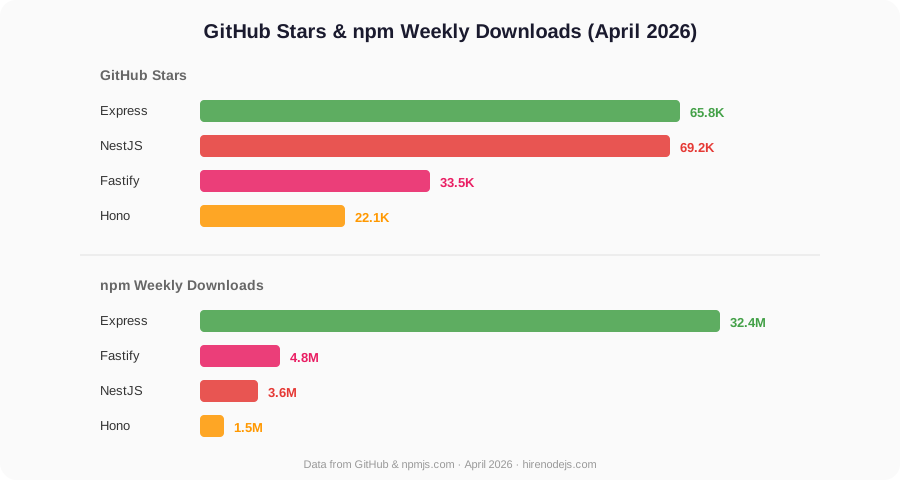
A framework's ecosystem determines how many problems are already solved for you. Middleware, plugins, ORMs, authentication libraries — these save weeks of development time.
Key Ecosystem Insights
- Express's 32.4M weekly downloads dwarfs the competition by 6-20x. This isn't just inertia — it means virtually every Node.js tutorial, course, and boilerplate starts with Express. Hiring is easier because every Node.js developer knows it.
- NestJS leads in GitHub stars (69.2K) reflecting strong developer enthusiasm. Its Angular-inspired architecture attracts enterprise teams who value structure and conventions.
- Fastify's 4.8M downloads show serious production adoption. Companies like Microsoft, Walmart, and Discord use Fastify for performance-critical services.
- Hono is the fastest-growing — from near-zero to 1.5M weekly downloads in under two years. Its edge-native approach positions it perfectly for the serverless era.
When to Use Each Framework: The Decision Guide
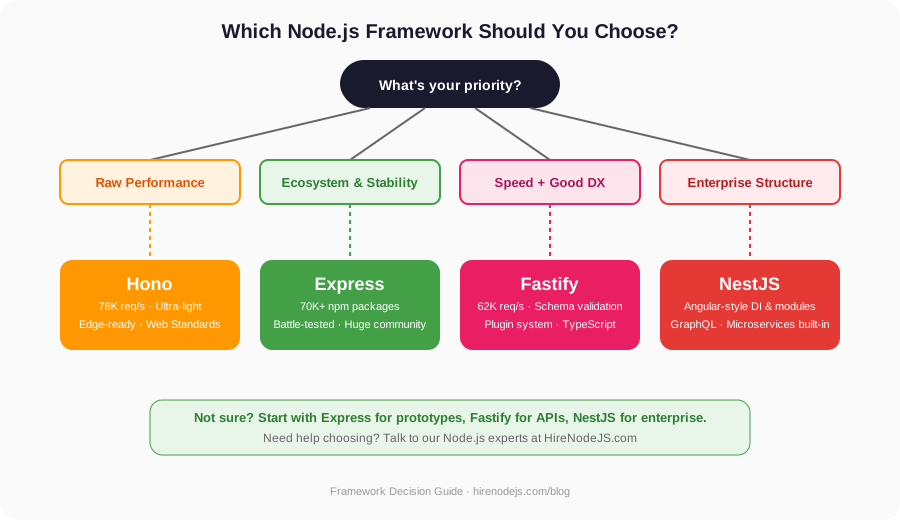
Rather than declaring a single "winner," the right choice depends on your specific constraints. Here's our framework selection guide based on working with hundreds of Node.js teams:
Express: Best For
Hire Pre-Vetted Node.js Developers
Skip the months-long search. Our exclusive talent network has senior Node.js experts ready to join your team in 48 hours.
- Rapid prototyping and MVPs where speed-to-market matters most
- Teams with junior developers who can leverage the massive tutorial ecosystem
- Projects that rely heavily on third-party middleware (authentication, session management, file uploads)
- Legacy applications and incremental modernization projects
Fastify: Best For
- High-throughput REST APIs where every millisecond of latency matters
- Teams that want built-in request/response validation via JSON Schema
- Microservices that need to handle 50K+ requests per second per instance
- Projects where TypeScript-first development is a priority
NestJS: Best For
- Large enterprise applications with 10+ developers on the backend team
- Teams coming from Angular, Spring Boot, or .NET who want familiar patterns
- Projects requiring built-in GraphQL, WebSockets, or microservice communication (gRPC, MQTT)
- Organizations that need strict architectural guardrails to maintain code quality at scale
Hono: Best For
- Edge computing and serverless deployments (Cloudflare Workers, Vercel Edge Functions)
- Teams building APIs that need to run on multiple JavaScript runtimes (Node, Deno, Bun)
- Lightweight services where bundle size directly impacts cold start performance
- Greenfield projects where Web Standards alignment is valued
The Hiring Factor: Framework Choice Affects Your Talent Pool
At HireNodeJS, we see a direct correlation between framework choice and hiring difficulty. Here's what the Node.js developer talent market looks like in 2026:
- Express developers: Easiest to find. Almost every Node.js developer has Express experience. Average salary: $95K-$140K (US).
- NestJS developers: Growing supply. Strong overlap with Angular developers. Average salary: $110K-$160K (US). Higher salary reflects architectural knowledge.
- Fastify developers: Moderate supply. Often overlaps with Express developers who've leveled up. Average salary: $105K-$155K (US).
- Hono developers: Smallest pool but growing rapidly. These developers tend to be experienced and command premium rates. Average salary: $120K-$170K (US).
If you're building a team and need to hire quickly, Express or NestJS give you the largest Node.js developer talent pool. If you're willing to invest in onboarding, Fastify developers often transition from Express with minimal ramp-up time.
Migration Paths: You're Not Locked In
One of the advantages of the Node.js ecosystem is that migration between frameworks is manageable. Here are the most common migration paths we see:
- Express → Fastify: The most common upgrade path. Fastify's fastify-express plugin lets you run Express middleware during migration. Expect 2-4 weeks for a medium-sized API.
- Express → NestJS: A bigger architectural shift. NestJS uses Express under the hood by default, so individual routes can be migrated incrementally. Budget 4-8 weeks for a full migration.
- Any framework → Hono: Hono's lightweight nature makes it easy to adopt for new services while keeping existing services on their current framework.
The Bottom Line: Our Framework Recommendations for 2026
After working with hundreds of Node.js teams, here's our no-nonsense recommendation: Start with Fastify for new APIs. It offers the best balance of performance, developer experience, and ecosystem maturity. Use NestJS when your team exceeds 8-10 backend developers and architectural consistency becomes more valuable than raw flexibility. Choose Hono for edge deployments and serverless functions. And there's nothing wrong with Express for prototypes and smaller applications — it still gets the job done.
Whichever framework you choose, the quality of your developers matters more than the framework itself. A great Node.js developer can build production-grade APIs with any of these tools. Need help finding them? Browse our vetted Node.js developers or get in touch with our team.
Need a senior developer who knows your chosen framework inside out? Browse pre-vetted Node.js developers on HireNodeJS.com — 48-hour deployment, strict NDA/IP, zero backout risk. We handle payroll and compliance so you ship faster.
Frequently Asked Questions
Which Node.js framework is fastest in 2026?
Hono leads at ~78,200 requests per second in JSON serialization benchmarks, followed by Fastify at ~62,400 req/s. However, raw framework performance rarely determines real-world application speed — database queries and business logic are usually the bottleneck.
Should I switch from Express to Fastify?
If your API handles high traffic (50K+ req/s) or you want built-in schema validation, Fastify is worth the switch. For smaller applications, Express remains perfectly adequate. The migration is straightforward using Fastify's fastify-express compatibility plugin.
Is NestJS good for startups?
NestJS excels when your team exceeds 8-10 backend developers and architectural consistency matters more than flexibility. For small startups (2-5 developers), Express or Fastify are typically faster to build with.
What is Hono and why is it popular?
Hono is a Web Standards-based framework that runs on Node.js, Deno, Bun, and edge runtimes like Cloudflare Workers. Its ultralight design (14KB) delivers exceptional performance with near-zero cold starts, making it ideal for serverless deployments.
Can NestJS use Fastify instead of Express?
Yes. NestJS supports swapping its HTTP adapter from Express to Fastify with a single configuration change. This can boost throughput by 40-60% while keeping NestJS's architectural patterns intact.
Vivek Singh is the founder of Witarist and HireNodeJS.com — a platform connecting companies with pre-vetted Node.js developers. With years of experience scaling engineering teams, Vivek shares insights on hiring, tech talent, and building with Node.js.
Need Node.js Developers Who Know These Frameworks?
Our vetted developers have production experience with Express, Fastify, NestJS, and Hono. Get matched with the right talent in 48 hours.
Continue Reading

Node.js vs Python for Backend Development: Which to Choose in 2026
A comprehensive comparison of Node.js and Python for backend development in 2026. Performance benchmarks, hiring costs, ecosystem analysis, and expert recommendations.

How to Hire Node.js Developers in 2026: The Complete Guide
Salary benchmarks, technical screening tactics, red flags, and hiring models for Node.js developers in 2026.

Why You Should Hire Dedicated Node.js Developers in 2025
Discover why dedicated Node.js developers are the smartest investment for startups and enterprises in 2025. Learn the cost benefits, performance gains, and hiring strategies that give you a competitive edge.