
How to Hire Node.js Developers in 2026: The Complete Guide
Node.js remains one of the most in-demand backend technologies in 2026. Used by 48.7% of professional developers worldwide (Stack Overflow, 2025), it powers everything from fast-growing startups to enterprise APIs at Netflix, LinkedIn, and Uber. But here's the problem: with demand this high, the talent market is noisy. Knowing how to hire Node.js developers who are actually production-ready — not just resume-ready — is what separates engineering teams that scale from ones that stall.
This guide walks you through the complete 2026 hiring playbook: current salary benchmarks, must-have skills, technical screening tactics, red flags to avoid, and which hiring model fits your stage.
The 2026 Node.js Talent Landscape
The Node.js job market in 2026 is competitive but navigable — if you know what you're looking for. Here's what hiring managers need to know:
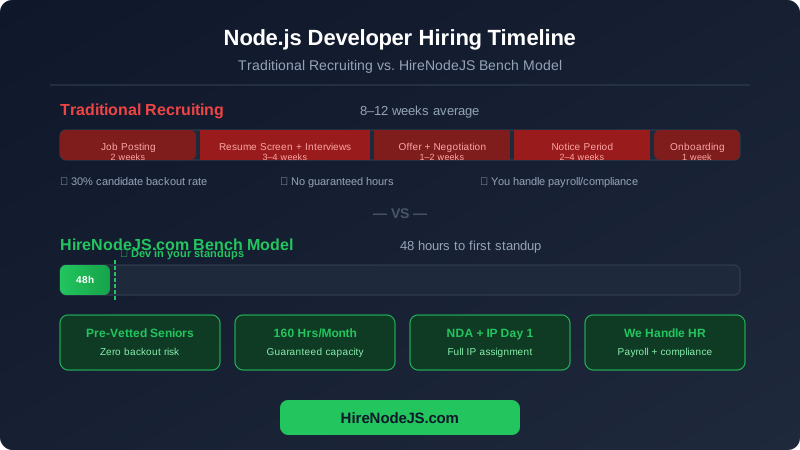
Skip the 8-week hiring process — browse pre-vetted Node.js developers on HireNodeJS.com and get senior talent joining your standups within 48 hours.
- Demand is accelerating:
- Demand is accelerating: Node.js server-side usage grew 48% year-over-year in 2025. Cloud adoption and full-stack JavaScript are the primary drivers.
- TypeScript is no longer optional: Roughly 75% of production Node.js codebases have migrated or are actively migrating to TypeScript. A candidate who only knows vanilla JS is a risk.
- NestJS dominates enterprise: For teams building microservices or large-scale APIs, NestJS has eaten significant market share from bare Express setups. Look for this specifically if you're enterprise-grade.
- Supply is tight at the senior level: Senior Node.js engineers with NestJS, microservices, and real-time experience are in short supply. Expect to pay a premium or look globally.
Node.js Developer Salary Benchmarks (2026)
Before you post a job or negotiate an offer, anchor yourself with real 2026 numbers. Here's what the market looks like by tier:
United States (Full-Time)
- Entry-level (0–2 years): $70,000 – $95,000/year
- Mid-level (2–5 years): $110,000 – $142,000/year
- Senior (5+ years): $150,000 – $210,000/year
- Staff / Principal engineer: $200,000 – $260,000+ (with equity)
Freelance / Contract Rates (US-Based)
- Mid-level freelancers: $55 – $75/hour
- Senior freelancers: $80 – $120/hour
- Architects / specialists: $120 – $180/hour
Offshore / Nearshore (Staff Augmentation)
- Eastern Europe (Poland, Ukraine): $50 – $80/hour
- Latin America (Brazil, Colombia): $40 – $65/hour
- South / Southeast Asia: $25 – $50/hour
Key takeaway: Seniors with NestJS, microservices, and TypeScript experience consistently push past the upper ranges. Budget accordingly or you'll lose them to competing offers.
Core Skills to Evaluate Before You Hire
Not all Node.js developers are created equal. Here are the skill tiers to assess, from must-have to nice-to-have:
Non-Negotiables (Must-Have in 2026)
- Node.js 20+ runtime proficiency and event loop mastery
- TypeScript — interfaces, generics, strict mode
- Async/await, Promises, and error propagation patterns
- REST API design and at least one of: Express, Fastify, or NestJS
- Database fluency — PostgreSQL or MongoDB plus query optimization
- Basic security: input validation, JWT auth, rate limiting, SQL injection prevention
- Git, CI/CD basics, and writing testable code (Jest or Vitest)
Strong Differentiators (Senior Level)
- Microservices architecture and inter-service communication (gRPC, message queues)
- WebSockets or SSE for real-time features
- Redis for caching and session management
- Containerization (Docker) and Kubernetes awareness
- Performance profiling and memory leak diagnosis
Bonus Points (Nice-to-Have)
- GraphQL API design (Apollo or Mercurius)
- Serverless (AWS Lambda with Node.js runtime)
- OpenTelemetry or distributed tracing experience
How to Technically Screen Node.js Developers
The 2026 interview landscape has shifted. Companies that just ask "what is the event loop?" are getting gamed by candidates who memorized answers from LLMs. You need to screen for genuine depth.
The 3-Stage Screening Framework
- Stage 1 — Async phone screen (30 min):
Hire Pre-Vetted Node.js Developers
Skip the months-long search. Our exclusive talent network has senior Node.js experts ready to join your team in 48 hours.
- Stage 1 — Async phone screen (30 min): Ask them to explain their last Node.js project architecture. Strong candidates ask clarifying questions and discuss trade-offs, not just features.
- Stage 2 — Live code review (45 min): Give them a Node.js route handler with deliberate issues: no input validation, a swallowed promise error, a blocking synchronous file read inside a request, and hardcoded DB credentials. See what they catch and how they fix it.
- Stage 3 — System design (45 min): Present a real-world scenario (e.g., "design a rate-limited notification service handling 50K events/minute"). Evaluate how they reason about queues, persistence, failure modes, and observability.
10 Interview Questions That Reveal True Depth
- Explain Node.js's event loop phases and where each type of callback runs.
- What happens when you await a rejected promise without a try/catch?
- How would you prevent a CPU-intensive task from blocking the event loop?
- Walk me through how you'd debug a memory leak in production.
- When would you choose Fastify over Express, and why?
- How does NestJS dependency injection work under the hood?
- What's the difference between horizontal and vertical scaling in Node.js?
- How would you implement backpressure in a Node.js stream pipeline?
- Describe how you'd architect a multi-tenant SaaS API with row-level security.
- How do you handle graceful shutdown in a containerized Node.js service?
Red Flags to Watch For
These warning signs show up repeatedly in failed Node.js hires. Watch for:
- Framework obsession without fundamentals: Knows NestJS decorators but can't explain closures or prototype chains. Frameworks change; JS doesn't.
- Vague about past projects: Can't explain their actual contributions vs. the team's. Often signals minimal hands-on involvement.
- No opinion on testing or CI/CD: Someone who doesn't write tests or use version control professionally will become technical debt fast.
- Can't discuss security: If they haven't thought about injection attacks, auth token expiry, or rate limiting, they'll build vulnerable APIs.
- Prioritizes features over architecture: In async systems, technical debt compounds fast. A "we'll refactor later" mindset at the wrong stage is costly.
Which Hiring Model Is Right for Your Stage?
Not every company should hire the same way. Here's a framework based on company stage:
Freelancer — Best for Startups (0–10 engineers)
Ideal for short-term projects, MVPs, or filling a specific gap. Fastest to spin up (days), but requires strong specs and communication. Typically costs $65–120/hour for quality work.
Staff Augmentation / Dedicated Developer — Best for Growth Stage
Your team leads, the developer executes. Best if you need sustained output for 3–12 months without full-time overhead. Platforms like HireNodeJS.com pre-vet developers so you skip the 5–9 week direct hire cycle and get a shortlist in 5–10 business days.
Full-Time Hire — Best for Scaling Companies
For core product teams where long-term ownership and culture fit matter. Budget 5–9 weeks for direct hiring. Consider supplementing with pre-vetted talent platforms to speed up the pipeline.
Offshore Team — Best for Enterprises with High Volume
Works well for large-scale projects with solid internal PMs and QA processes. Eastern Europe and Latin America offer the best quality-to-cost ratio in 2026. Requires strong async communication culture.
How to Write a Node.js Job Description That Attracts Senior Engineers
90% of strong Node.js developers respond only to targeted, specific outreach. Generic JDs get ignored. Here's what works in 2026:
- Be specific about the stack: "Node.js 20+, NestJS, TypeScript, PostgreSQL, Redis, Docker" outperforms "backend development experience"
- Mention the problem space: Senior engineers want to know what they're building, not just "work on our product."
- List scale: "Handles 2M API calls/day" or "real-time data for 100K users" tells experienced engineers whether the challenge is interesting.
- Include salary range: Postings with salary ranges get 40%+ more qualified applications. Stop hiding the number.
- Use concentric skill requirements — hard requirements, preferred, and bonus — so senior candidates don't self-reject over non-critical skills
The Fastest Path: Pre-Vetted Node.js Developers
If you're on a growth timeline and can't afford a 5–9 week hiring cycle, the fastest path is a pre-vetted talent platform. HireNodeJS.com connects companies with Node.js developers who have already passed technical assessments, code reviews, and real-world project evaluations. You get a curated shortlist — typically in under 10 business days — and skip the top-of-funnel grind entirely.
This model works especially well when you need:
- A senior Node.js developer for 3–6 months to ship a specific product milestone
- Offshore talent without the risk of sourcing unknown vendors
- A team extension while you build out your full-time engineering org
Hire Expert Node.js Developers — Ready in 48 Hours
Building the right thing is only half the battle — you need the right engineers to build it. HireNodeJS.com specialises exclusively in Node.js talent, which means every developer in our network has been pre-vetted on real-world Node.js projects: API design, event-driven architecture, performance tuning, and production deployments.
Unlike generalist platforms where you sift through hundreds of irrelevant profiles, our curated pool means you speak only to engineers who live and breathe Node.js. Most clients have their first developer working within 48 hours of getting in touch.
Whether you need a senior engineer to architect a greenfield system, a mid-level developer to accelerate your current team, or a specialist to tackle a specific challenge like real-time features or microservices migration — HireNodeJS.com has the talent. Engagements start as short-term contracts and can convert to full-time hires with no placement fee.
Whether you're hiring your first backend developer or scaling a 50-person engineering team, starting with pre-vetted candidates cuts your time-to-productivity in half.
Ready to hire? Browse available Node.js developers — we'll send you 3 curated senior profiles within 48 hours. Payroll, compliance, and IP protection handled.
Frequently Asked Questions
How long does it take to hire a Node.js developer?
Direct hiring typically takes 5–9 weeks end-to-end once you factor in sourcing, screening, interviews, and notice periods. Using a pre-vetted talent platform like HireNodeJS.com can reduce this to 5–10 business days for a curated shortlist of qualified candidates.
What should I pay a senior Node.js developer in 2026?
In the United States, senior Node.js developers (5+ years) typically earn $150,000–$210,000/year in full-time roles. Freelance senior rates run $80–$120/hour for US-based talent, while offshore senior developers in Eastern Europe or Latin America cost $50–$80/hour.
Is TypeScript required for Node.js developers in 2026?
Yes — TypeScript is now an industry standard for production Node.js applications. Approximately 75% of production Node.js codebases have migrated or are actively migrating. When hiring, treat TypeScript proficiency as a hard requirement rather than a nice-to-have.
What's the best way to technically screen Node.js candidates?
The most effective 2026 approach combines: (1) an architecture discussion where you ask about their last production system, (2) a live code review of a flawed Express/NestJS handler with deliberate bugs, and (3) a system design scenario requiring async reasoning. Avoid trivia-style questions — they're too easy to game.
Should I hire a freelancer or a dedicated Node.js developer?
It depends on your stage. Freelancers are best for short-term projects or MVPs (weeks to 2 months). Dedicated developers (via staff augmentation) are ideal for growth-stage companies needing consistent output over 3–12 months. Full-time hires make sense when you need long-term ownership and culture alignment.
Vivek Singh is the founder of Witarist and HireNodeJS.com — a platform connecting companies with pre-vetted Node.js developers. With years of experience scaling engineering teams, Vivek shares insights on hiring, tech talent, and building with Node.js.
Ready to Hire Node.js Developers?
Browse our pre-vetted talent network and get matched with senior Node.js developers in 48 hours.
Continue Reading

How to Hire Node.js Developers in 2026: Salaries, Skills & Red Flags
A practical 2026 guide to hiring Node.js developers — covering salaries, must-have skills, screening tactics, and red flags to avoid.
Node.js Staff Augmentation: Scale Your Team in 2026
Scale your Node.js backend team fast with staff augmentation. Includes 2026 rate benchmarks by region, provider vetting criteria, onboarding checklists, and real cost comparisons.
Best Node.js Frameworks in 2026: Express vs Fastify vs NestJS vs Hono
A comprehensive comparison of the top Node.js frameworks in 2026 — Express, Fastify, NestJS, and Hono — with performance benchmarks, code examples, ecosystem stats, and a decision guide for engineering teams.