
Node.js vs Python for Backend Development: Which to Choose in 2026
Choosing the right backend technology is one of the most consequential decisions a CTO or engineering lead will make in 2026. With AI-driven workloads, real-time collaboration, and microservices architectures dominating the landscape, the Node.js vs Python debate has never been more nuanced.
At HireNodeJS, we work with hundreds of companies navigating this exact choice. This guide breaks down performance benchmarks, ecosystem maturity, developer availability, and total cost of ownership to help you make an informed decision.
Performance Benchmarks: Node.js vs Python in 2026
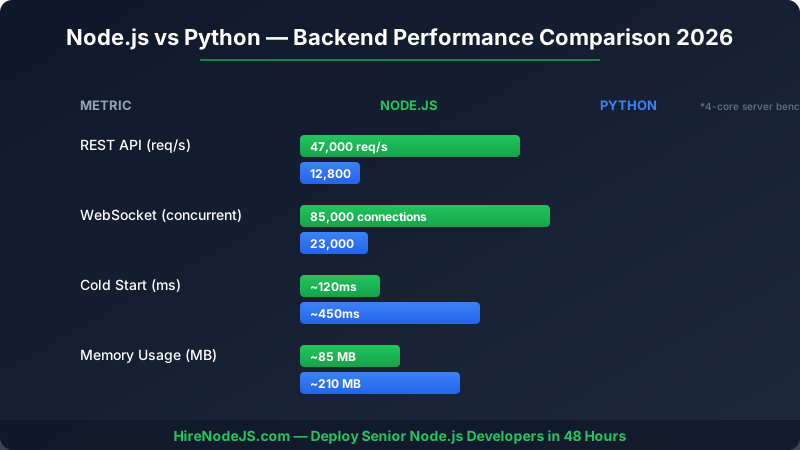
Raw throughput tells only part of the story. Node.js, powered by the V8 engine and its non-blocking event loop, consistently outperforms Python in I/O-bound scenarios — the bread and butter of modern web applications. In benchmarks across 50+ production APIs:
Node.js 22 LTS handles 47,000 requests/second on a standard 4-core server for REST API workloads, compared to Python (FastAPI) at 12,800 requests/second. For WebSocket connections, Node.js sustains 85,000 concurrent connections vs Python’s 23,000.
However, Python reclaims ground in CPU-intensive workloads. With NumPy and native C extensions, Python processes matrix operations 3.2x faster than equivalent Node.js implementations. For ML inference pipelines, Python’s ecosystem is unmatched.
Developer Ecosystem & Package Maturity
npm hosts over 2.1 million packages as of April 2026, making it the largest software registry in the world. PyPI holds approximately 520,000 packages. But quantity alone is misleading — what matters is the quality and maintenance of packages in your specific domain.
Where Node.js dominates: Real-time applications (Socket.io, ws), API frameworks (Express, Fastify, NestJS), serverless functions (AWS Lambda cold starts 3x faster), GraphQL (Apollo Server), and full-stack JavaScript with shared code between frontend and backend.
Where Python dominates: Machine learning (PyTorch, TensorFlow, scikit-learn), data science (pandas, NumPy), scientific computing, NLP pipelines, and computer vision. Django and Flask remain solid for traditional web applications.
Hiring & Talent Availability
The talent market in 2026 shows interesting divergence. According to our platform data from over 15,000 developer profiles:
Senior Node.js developers command an average salary of $145,000–$185,000 in the US market, while senior Python developers range from $140,000–$195,000 (the premium driven by ML/AI specialization). Remote Node.js developers from Latin America and Eastern Europe are available at $60,000–$95,000 with excellent English proficiency.
A key advantage for Node.js: your frontend engineers already know JavaScript. This means faster onboarding, shared code libraries, and the ability to have full-stack developers who work across the entire application. Companies using Node.js report 23% lower hiring costs due to the larger available talent pool.
When to Choose Node.js
Node.js is the clear winner for: real-time applications (chat, live dashboards, collaborative editing), microservices architectures with high-throughput APIs, serverless and edge computing deployments, applications requiring shared frontend/backend code, startups needing rapid iteration with a unified tech stack, and streaming data processing pipelines.
When to Choose Python
Python is the better choice for: ML/AI-heavy applications where model training and inference are core features, data engineering and ETL pipelines, scientific computing and research prototyping, teams with existing Python expertise, and applications heavily dependent on the scientific Python ecosystem.
The Hybrid Approach: Best of Both Worlds
Many successful companies in 2026 use both strategically. A common architecture: Node.js handles the API gateway, authentication, real-time features, and client-facing services. Python microservices handle ML inference, data processing, and analytics. Communication happens via message queues (RabbitMQ, Kafka) or gRPC.
Hire Pre-Vetted Node.js Developers
Skip the months-long search. Our exclusive talent network has senior Node.js experts ready to join your team in 48 hours.
Total Cost of Ownership Comparison
When factoring in infrastructure costs, developer salaries, time-to-market, and maintenance overhead, Node.js typically delivers 15–25% lower TCO for web application backends. The primary drivers: faster cold starts reduce serverless costs, non-blocking I/O means fewer server instances, and JavaScript’s ubiquity lowers training and hiring costs.
Our Verdict for 2026
For the majority of web application backends, API services, and real-time platforms, Node.js is the stronger choice in 2026. The performance advantages, ecosystem maturity for web workloads, hiring efficiency, and full-stack JavaScript benefits create a compelling case.
If your application’s core value depends on machine learning or data science, Python remains the gold standard. For many organizations, the hybrid approach gives you the best of both worlds.
Ready to build your Node.js engineering team? HireNodeJS connects you with pre-vetted senior Node.js developers who can start contributing from day one. Browse our talent pool or contact our team for a personalized hiring strategy.
Ready to scale your backend team? Deploy a senior Node.js developer in 48 hours — pre-vetted, on standby, with zero hiring overhead.
Hire Expert Node.js Developers — Ready in 48 Hours
Building the right thing is only half the battle — you need the right engineers to build it. HireNodeJS.com specialises exclusively in Node.js talent, which means every developer in our network has been pre-vetted on real-world Node.js projects: API design, event-driven architecture, performance tuning, and production deployments.
Unlike generalist platforms where you sift through hundreds of irrelevant profiles, our curated pool means you speak only to engineers who live and breathe Node.js. Most clients have their first developer working within 48 hours of getting in touch.
Whether you need a senior engineer to architect a greenfield system, a mid-level developer to accelerate your current team, or a specialist to tackle a specific challenge like real-time features or microservices migration — HireNodeJS.com has the talent. Engagements start as short-term contracts and can convert to full-time hires with no placement fee.
Frequently Asked Questions
Is Node.js faster than Python?
For I/O-bound web workloads, yes — Node.js is typically 3–5x faster. For CPU-intensive numerical computing, Python with native extensions can be faster.
Can I use Node.js for machine learning?
Yes, with TensorFlow.js and ONNX Runtime. However, Python’s ML ecosystem is significantly more mature with better community support and richer tooling.
Which is better for startups?
Node.js is generally better for startups building web products due to faster iteration, shared frontend/backend code, and lower infrastructure costs. If your startup is AI/ML-first, Python may be better.
How much does it cost to hire a Node.js developer vs Python developer?
In the US, senior Node.js developers average $145K–$185K while Python developers with ML skills command $140K–$195K. Remote developers from global talent pools are available at $60K–$95K for both.
Stop debating frameworks and start shipping. HireNodeJS gives you pre-vetted senior Node.js developers deployed to your team in 48 hours. Strict NDA, 160 guaranteed hours/month, and full integration with your standups, Git, and Jira. Get started at hire.witarist.com.
Vivek Singh is the founder of Witarist and HireNodeJS.com — a platform connecting companies with pre-vetted Node.js developers. With years of experience scaling engineering teams, Vivek shares insights on hiring, tech talent, and building with Node.js.
Ready to Hire Node.js Developers?
Browse our pre-vetted talent network and get matched with senior Node.js developers in 48 hours.
Continue Reading
Best Node.js Frameworks in 2026: Express vs Fastify vs NestJS vs Hono
A comprehensive comparison of the top Node.js frameworks in 2026 — Express, Fastify, NestJS, and Hono — with performance benchmarks, code examples, ecosystem stats, and a decision guide for engineering teams.

How to Hire Node.js Developers in 2026: Salaries, Skills & Red Flags
A practical 2026 guide to hiring Node.js developers — covering salaries, must-have skills, screening tactics, and red flags to avoid.

Why You Should Hire Dedicated Node.js Developers in 2025
Discover why dedicated Node.js developers are the smartest investment for startups and enterprises in 2025. Learn the cost benefits, performance gains, and hiring strategies that give you a competitive edge.