Node.js Staff Augmentation: Scale Your Team in 2026
You needed to ship a new Node.js microservice two months ago. Your team is maxed out. Recruiting takes 8 weeks. Node.js staff augmentation solves this — giving you production-ready developers in days, not months.
The global IT staff augmentation market is projected to exceed $81.9 billion by 2025 growing at 13.2% CAGR. Node.js, used by 48.7% of professional developers worldwide (Stack Overflow, 2025), powers backends at Uber, LinkedIn, and thousands of startups. Yet senior Node.js talent remains scarce. Staff augmentation is how smart engineering leaders close the gap without the overhead of a full-time hire.
What Is Node.js Staff Augmentation?
If you need senior Node.js developers on your team within 48 hours, browse pre-vetted developers on HireNodeJS.com — every engineer has been assessed on event loop internals, async patterns, and production systems design.
Staff augmentation is a flexible hiring model where external developers join your team directly — attending your standups, using your Jira board, working in your Git workflow, and reporting to your engineering leadership. Unlike outsourcing (where you hand off a project to an external team), augmented developers are your developers for the duration of the engagement. You retain full control over architecture, code quality, and sprint priorities.
The Three Staff Augmentation Models
Dedicated remote developers work exclusively on your project in long-term (3-12+ month) engagements. They become deeply familiar with your codebase and team culture — the closest substitute for a full-time hire without the overhead.
On-demand specialists bring targeted expertise for a specific sprint, migration, or performance bottleneck — ideal for a TypeScript migration or a GraphQL refactor you need completed in 4-6 weeks.
Team pod augmentation gives you a pre-assembled unit (typically a senior Node.js engineer, a mid-level, and a QA) operating as a cohesive team within your larger organization. Ideal for startups spinning up a second product line.
When Staff Augmentation Beats Direct Hiring
Direct hiring makes sense for your permanent core team. But for the following scenarios, staff augmentation consistently delivers better ROI, speed, and flexibility.
You Have a Short Runway to Ship
Direct hiring averages 5-9 weeks end-to-end (sourcing, screening, offers, notice periods). A pre-vetted augmentation provider can have a senior Node.js developer joining your standups in 5-10 business days. If you are 6 weeks from a product launch and two engineers short, there is no realistic alternative.
You Need a Niche Skill for Under 6 Months
Hiring a full-time Fastify specialist or GraphQL/Node.js architect to solve one architectural challenge creates a long-term payroll obligation. Augmentation lets you bring the expertise in, solve the problem, and release the engagement cleanly — no messy exits.
You Are Scaling Internationally
Building a second engineering shift in Eastern Europe or LatAm? Staff augmentation removes the complexity of international hiring. No legal entity required, no local labor law compliance, no HR overhead. The augmentation partner handles payroll, benefits, and local compliance.
// Senior Node.js Screening Test: Event Loop + Memory Management (30 min)

// Q1: Predict the exact output order
console.log("A");
setTimeout(() => console.log("B"), 0);
Promise.resolve().then(() => console.log("C"));
process.nextTick(() => console.log("D"));
console.log("E");
// Expected output: A E D C B
// Explanation: sync -> nextTick queue -> microtask (Promise) -> macrotask (setTimeout)
// Weak candidates say A E C D B (confuse nextTick with Promise order)

// Q2: Find and fix the production memory leak
class ConnectionPool {
  constructor() {
    this.connections = new Map();
    // PROBLEM: No eviction policy - Map grows unbounded
  }

  async getConnection(key) {
    if (!this.connections.has(key)) {
      const conn = await createDbConnection(key);
      this.connections.set(key, conn); // Memory leak in long-running services
    }
    return this.connections.get(key);
  }
}

// FIX: Add LRU eviction or TTL-based cleanup
// Strong answer also mentions: max pool size, connection health checks,
// and graceful shutdown (process.on("SIGTERM", cleanup))
This 30-minute screening question separates Node.js enthusiasts from engineers who have debugged production systems at scale. Senior candidates immediately spot the Map memory leak, correctly order the event loop output (including the often-missed nextTick vs Promise queue distinction), and discuss graceful shutdown patterns.
How to Vet a Node.js Staff Augmentation Provider
Not all augmentation providers are equal. The worst send un-vetted resumes and call it talent delivery. The best send engineers shipping code in week one. Here is how to tell the difference before you sign a contract.
Ask About Their Technical Vetting Pipeline
Any credible Node.js staffing firm conducts at minimum: an async coding challenge, a live systems design interview, and an English communication assessment. Ask for their acceptance rate. The best providers accept fewer than 3% of applicants. If they cannot describe their vetting pipeline, keep looking.
Hire Pre-Vetted Node.js Developers
Skip the months-long search. Our exclusive talent network has senior Node.js experts ready to join your team in 48 hours.
Check the Bench (Available Now vs. Recruiter Disguise)
Ask: "How many pre-vetted senior Node.js developers can you introduce this week?" If the answer is "let me post a job," they do not maintain a bench. True augmentation firms can introduce you to available talent within 24-48 hours. Anyone else is a recruiter adding a margin.
Get Engineering References, Not HR References
Request 2-3 references from CTOs or VPs of Engineering specifically. You want to hear about code quality, communication in standups, and how quickly the developer was productive — not whether they showed up on time. Red flag: references who only speak in vague superlatives.
Onboarding Remote Node.js Developers for Fast Ramp-Up
The biggest ROI killer in staff augmentation is slow onboarding. A senior developer taking 6 weeks to become productive eats the speed advantage you hired for. Teams that get augmented developers shipping in week one follow a structured 5-day plan.
# Node.js Developer Onboarding Checklist (Remote)

## Day 1: Access and Orientation
- [ ] GitHub org invite — repo read access, write to assigned repos
- [ ] Jira/Linear access with explanation of ticket conventions
- [ ] Slack: add to #engineering, #backend, #deploys channels
- [ ] Share .env.example and internal documentation links
- [ ] Assign an onboarding buddy (senior IC, not a manager)

## Days 2-3: Codebase Immersion
- [ ] 90-min architecture walkthrough: services, data flow, external APIs
- [ ] First PR: a small, scoped bug fix — never a feature
- [ ] Code review session to calibrate standards and conventions
- [ ] Walk through CI/CD pipeline and deployment runbook

## Week 1 Milestone
- [ ] First real feature card assigned (small, well-scoped)
- [ ] Paired on first complex problem
- [ ] 15-min check-in with engineering manager

## Week 2 Readiness Signals
- [ ] Opening PRs independently with clear descriptions
- [ ] Asking questions in ticket comments, not Slack DMs
- [ ] Proactively identifying edge cases the ticket author missed
The single most effective onboarding tactic: assign a scoped bug fix as the first PR (Day 2), not a feature. This forces the developer to read the codebase deeply, understand your conventions, and produce reviewable code in your actual system context.
Managing Timezone Overlap Effectively
For US-based teams augmenting with Eastern European or LatAm developers, target a minimum of 4 hours of daily overlap. Run standup at 9-10 AM ET. Less than 3 hours of overlap turns collaboration into an asynchronous queue and deliverables decelerate. For India-based developers, US West Coast teams (PT) have natural overlap during 8-11 AM PT; East Coast (ET) teams often need 7-8 AM standups to make it work.
Cost Breakdown: Staff Augmentation vs Direct Hire in 2026
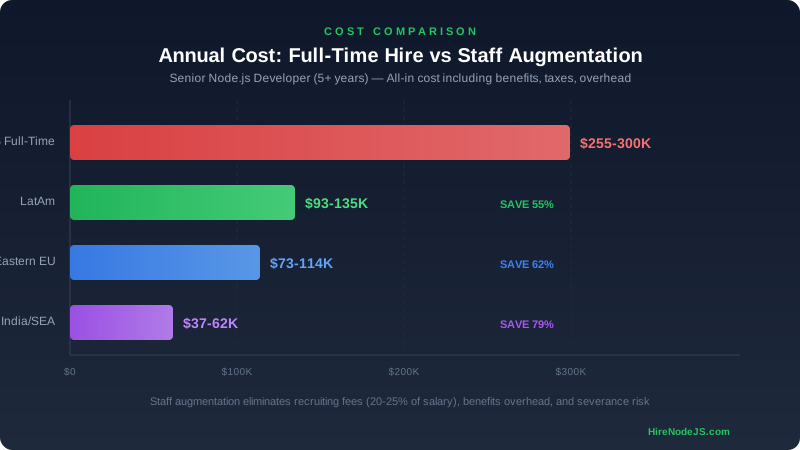
The cost comparison is striking — and grows more favorable at senior levels. The following figures represent the all-in cost of a senior Node.js developer (5+ years) in 2026:
US Full-Time Hire: $160-175K salary + $95-125K in benefits, payroll taxes, recruiting fees, and overhead = $255-300K annual all-in cost
Staff Augmentation — LatAm: $45-65/hr x 2,080 hrs/yr = $93K-$135K/year. No benefits. No equity. No recruiting fee.
Staff Augmentation — Eastern Europe: $35-55/hr x 2,080 hrs/yr = $73K-$114K/year. Strong time zone overlap for US EST teams.
Staff Augmentation — India/SEA: $18-30/hr x 2,080 hrs/yr = $37K-$62K/year. Largest talent pool; requires deliberate timezone management.
Beyond the headline rate, factor in what you avoid: no recruiting fees (typically 20-25% of first-year salary for direct hires), no severance risk if priorities change, and no benefits administration overhead. Staff augmentation cost savings reach 40-60% for offshore and 20-35% for nearshore engagements when calculated on a total cost basis.
Hidden Costs to Budget For
Staff augmentation has real costs beyond the hourly rate: onboarding time (1-2 weeks for an experienced developer), communication overhead (typically 10-15% higher for distributed teams), and potential knowledge loss when the engagement ends. These do not erase the advantage, but they narrow the headline number. Build them into your ROI calculation from the start.
Start Scaling Your Node.js Backend Team
The engineering teams that get the most out of staff augmentation treat it like hiring: they define the role clearly, run a real technical screen, and have an onboarding plan ready on Day 1. The teams that struggle treat it like a service subscription — and get what they pay for.
HireNodeJS.com connects engineering teams with pre-vetted, senior Node.js developers available for dedicated remote engagements. Every developer has been assessed on event loop architecture, async patterns, and real-world systems design — not just LeetCode. Most clients receive a curated shortlist within 5-10 business days.
Ready to scale your backend? Share your requirements and we will send you 3 pre-vetted senior Node.js developer profiles within the week.
Ready to scale your Node.js team? Browse available developers or book a call with our team to get 3 curated profiles within 48 hours. We handle payroll, HR compliance, and IP protection — you focus on shipping.
Frequently Asked Questions
How quickly can I get a Node.js developer through staff augmentation?
With a provider maintaining a pre-vetted bench, you can have a senior Node.js developer joining your standups in 5-10 business days. Providers who post jobs after receiving your request take 3-6 weeks, erasing the speed advantage. Always ask how many vetted developers are available right now.
What is the hourly rate for a senior Node.js developer via staff augmentation in 2026?
Rates vary by region: India and Southeast Asia run $18-30/hr, Eastern Europe $35-55/hr, Latin America $45-65/hr, and US-based contractors $70-120/hr for senior roles. These rates exclude benefits and HR overhead, making the effective savings over a US full-time hire substantial.
How is staff augmentation different from outsourcing for Node.js development?
Staff augmentation integrates external developers directly into your team — they join your standups, use your tools, and report to your engineering leadership. Outsourcing transfers a project or scope to an external team that works independently. Most product companies prefer augmentation when they need to maintain control over architecture and code quality.
How do I protect my IP when working with augmented Node.js developers?
Use standard NDAs and IP assignment agreements before Day 1. Grant repository access at the branch level rather than admin rights. The augmentation provider should co-sign the NDA. Conduct a security audit of any shared credentials when the engagement concludes.
What seniority level makes the most sense for staff augmentation?
Mid-to-senior developers (3+ years) deliver the best augmentation ROI. They ramp up quickly, require minimal oversight, and can own complex features independently. Junior developers require more management bandwidth that often negates the cost savings, especially in distributed engagements.
Vivek Singh is the founder of Witarist and HireNodeJS.com — a platform connecting companies with pre-vetted Node.js developers. With years of experience scaling engineering teams, Vivek shares insights on hiring, tech talent, and building with Node.js.
Ready to Hire Node.js Developers?
Browse our pre-vetted talent network and get matched with senior Node.js developers in 48 hours.
Continue Reading

How to Hire Node.js Developers in 2026: The Complete Guide
Salary benchmarks, technical screening tactics, red flags, and hiring models for Node.js developers in 2026.

How to Hire Node.js Developers in 2026: Salaries, Skills & Red Flags
A practical 2026 guide to hiring Node.js developers — covering salaries, must-have skills, screening tactics, and red flags to avoid.

Why You Should Hire Dedicated Node.js Developers in 2025
Discover why dedicated Node.js developers are the smartest investment for startups and enterprises in 2025. Learn the cost benefits, performance gains, and hiring strategies that give you a competitive edge.