
How to Hire Node.js Developers in 2026: Salaries, Skills & Red Flags
The demand for Node.js developers has never been higher. As of 2026, Node.js powers millions of production applications and is the backbone of real-time systems at companies like Netflix, LinkedIn, Uber, and PayPal. Yet despite its popularity, many hiring managers struggle to find — and properly evaluate — the right talent. "Node.js developer" on a resume can mean anything from a junior who completed a Udemy course to a seasoned architect who's built systems handling millions of concurrent connections.
This guide breaks down everything you need to know to hire a Node.js developer in 2026: what skills matter, realistic salary benchmarks, how to run an effective screening process, and the red flags that separate great developers from expensive mistakes.
Why Node.js Is Still Dominating Backend Development in 2026
Node.js was first released in 2009, but its relevance has only grown. Built on Chrome's V8 JavaScript engine, Node.js excels at handling high-concurrency, I/O-bound workloads — making it ideal for REST APIs, microservices, real-time features like chat and live notifications, and serverless functions. JavaScript remains the most widely used programming language for the eleventh consecutive year according to the Stack Overflow Developer Survey, and Node.js continues to be the most popular backend runtime.
In 2026, the Node.js ecosystem has matured significantly. TypeScript adoption is near-universal among professional teams. Frameworks like NestJS have brought enterprise-grade architecture patterns to the Node ecosystem. And with the rise of AI-powered products, Node.js has become the preferred API layer between frontend applications and Python-based machine learning microservices — a pattern known as the split architecture.
The bottom line: your talent pool is large, but so is the noise. Knowing how to filter for genuine expertise is what separates companies that build great Node.js teams from those that spend months and five-figure sums on mismatched hires.
Core Skills Every Node.js Developer Should Have in 2026
Not all Node.js developers are the same. Before writing a job description, define what your project actually needs. Here are the core competencies worth screening for.
TypeScript Is No Longer Optional
If a candidate cannot write TypeScript fluently in 2026, that is a serious gap. TypeScript has become the industry standard for production Node.js codebases, offering type safety, improved tooling, and significantly fewer runtime errors. Any developer who insists on writing vanilla JavaScript for a new production application is either inexperienced or behind on industry practices. During interviews, ask candidates to explain the difference between type aliases and interfaces, or how they handle typing third-party libraries without TypeScript support — these questions quickly reveal depth of experience.
Deep Understanding of the Event Loop and Async Patterns
Node.js's power lies in its non-blocking, event-driven architecture. A strong candidate should be able to explain — without prompting — how the event loop works, what the call stack, task queue, and microtask queue are, and why blocking the event loop is catastrophic in production. A reliable interview question: ask them to walk through what happens when you await a database query inside a for loop iterating over 10,000 items. Their answer will tell you everything about whether they understand production-grade async programming.
Framework Proficiency: Express, NestJS, or Fastify?
The three dominant Node.js frameworks in 2026 each serve different needs. Express.js remains the most widely used — minimalist, flexible, and excellent for microservices and straightforward APIs. NestJS is the enterprise choice, using TypeScript natively with decorators and a structured module system ideal for large teams. Fastify is the performance-first option, offering measurable throughput improvements for high-volume APIs.
Ask candidates to explain the trade-offs between these frameworks — not which one they "prefer," but when they'd choose each given specific project constraints. A senior developer should articulate this clearly. Someone who says "I only use NestJS" or "Express is outdated" is revealing limited exposure, not expertise.
Database and Infrastructure Knowledge
A well-rounded Node.js developer in 2026 should have working knowledge of both SQL databases (PostgreSQL is the standard) and NoSQL options (MongoDB for document storage, Redis for caching and session management). They should understand connection pooling, query optimization, and how to design APIs that avoid N+1 database query patterns. At the senior level, expect familiarity with AWS services like Lambda, API Gateway, and RDS — or equivalent GCP/Azure experience.
Node.js Developer Salaries in 2026: What to Budget
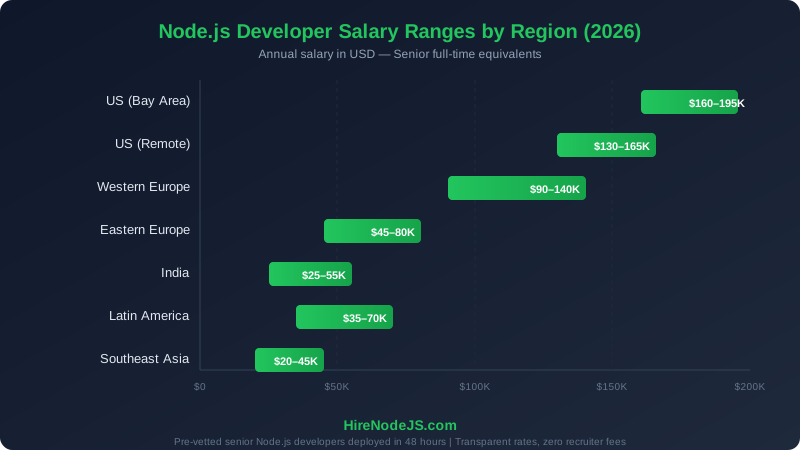
Salary planning is one of the most common pain points for technical hiring managers. Here is a realistic breakdown of Node.js developer compensation in the United States in 2026: Entry-level developers (0–2 years of experience) typically earn between $70,000 and $90,000 per year. Mid-level developers (3–5 years) command $95,000 to $130,000. Senior developers (5+ years) range from $140,000 to $180,000 or more, particularly in high-cost markets. Contractors and freelancers typically charge between $55 and $150 per hour depending on seniority and specialization.
Geography plays a significant role. Denver and Austin have emerged as competitive markets averaging $165,000–$175,000 for senior roles. If your team is fully remote, Eastern European developers offer comparable skills at 40–50% lower cost ($70,000–$100,000 annually), while Latin American developers typically range from $60,000 to $90,000.
One increasingly popular model is staff augmentation through a specialized platform — which compresses the typical 5–9 week direct hiring cycle down to 5–10 business days without sacrificing quality. For companies that need to ship quickly, this time difference often more than justifies any platform cost.
Where to Find Top Node.js Talent
Hire Pre-Vetted Node.js Developers
Skip the months-long search. Our exclusive talent network has senior Node.js experts ready to join your team in 48 hours.
The best Node.js engineers are rarely browsing job boards. Research consistently shows that roughly 90% of top-tier candidates respond only to targeted outreach — meaning companies that rely solely on inbound LinkedIn applications are missing most of the talent market. While you wait for applicants, your competitors are already closing offers with the developers you actually want.
More effective sourcing channels include GitHub (look for active contributors to Node.js projects and popular npm packages), the Node.js Discord and community Slack groups, Dev.to, and local or virtual meetups in the JavaScript ecosystem. Referrals from your existing engineering team remain the highest-quality source by conversion rate.
That said, the fastest and most reliable path is a specialized hiring platform. HireNodeJS.com maintains a curated network of pre-vetted Node.js developers who have already completed rigorous technical assessments, so your team meets only candidates worth your time. No job postings, no sifting through unqualified applications — just a shortlist of developers who are ready to work.
How to Run an Effective Screening Process
Interviewing Node.js developers should go well beyond whiteboard coding exercises. Here is a proven three-stage process that balances thoroughness with candidate experience.
Stage 1: Async Technical Screen (60–90 Minutes)
Use a timed take-home test or live coding platform (Codility, CodeSignal, or HackerRank work well). Focus on: async/await error handling, event emitter patterns, designing a REST endpoint that performs well under load, and one simple system design question. Keep it under two hours — anything longer will cause strong candidates with competing offers to drop out of your process.
Stage 2: Technical Interview (45 Minutes)
Focus on depth over breadth. Ask the candidate to walk through a meaningful past project: What went wrong? How did they debug it? What would they do differently? Candidates who can articulate failure and learning are far more valuable than those who claim everything they've built was flawless. Close with one architecture question — for example: "How would you design a rate limiter for a public API serving 10 million requests per day?" — to assess systems thinking.
Stage 3: Team and Culture Fit (30 Minutes)
Node.js backend developers often collaborate closely with frontend engineers (many share JavaScript fluency) and DevOps teams. Assess communication style, how the candidate handles technical disagreements, and whether they can explain complex concepts clearly to non-engineers. In a remote-first environment, written communication is as important as code quality.
Red Flags to Watch Out For
After reviewing thousands of Node.js developer profiles and conducting extensive technical screens, several patterns emerge as reliable predictors of poor hires:
Cannot explain the event loop. This is a dealbreaker, full stop. If a candidate calls themselves a Node.js developer but cannot explain non-blocking I/O and what happens when you run a synchronous CPU-intensive task on the main thread, they do not have a production-ready understanding of the platform.
No TypeScript experience. As noted above, TypeScript is standard in 2026. A candidate with zero TypeScript experience will require significant ramp-up time and may produce code that creates accumulating technical debt.
Portfolio full of tutorials. Strong candidates have real GitHub repositories with commit histories showing they have shipped actual features, handled production bugs, and iterated over time. Tutorial clones and course project repos are not the same as shipping production software.
Framework dogmatism. Candidates who insist one framework is always superior signal limited real-world exposure. Experienced developers choose tools based on project constraints, not personal attachment.
Poor written communication. In a remote-first world, developers who cannot clearly articulate their technical decisions in writing create ongoing coordination risk. This matters as much as code quality.
Why Pre-Vetted Talent Saves Time and Money
A bad hire for a senior Node.js developer role costs far more than just the salary. Industry estimates put the total cost of a failed technical hire — including recruitment spend, onboarding investment, productivity loss, and team disruption — at 1.5 to 2 times the annual salary. For a $160,000 role, that is a $240,000 to $320,000 mistake, and it rarely shows up cleanly on any single budget line.
Pre-vetting eliminates the most common failure modes. When a developer has already passed a multi-stage technical assessment — including live coding, system design review, and a code quality evaluation — you are starting the relationship with a dramatically higher baseline of confidence. The contract-to-hire conversion rate for pre-vetted Node.js developers is around 70%, compared to significantly lower rates for unvetted candidates found through traditional job postings.
HireNodeJS.com specializes exactly in this. Every developer in the network has been screened for TypeScript proficiency, architectural thinking, async programming depth, and real-world project experience. Companies get a curated shortlist in days rather than weeks, and they only meet developers who are ready to contribute from day one. Whether you are hiring a single senior backend engineer or building out a full Node.js team, starting with pre-vetted talent consistently produces better outcomes faster.
Ready to skip the hiring headaches? HireNodeJS.com gives you pre-vetted senior Node.js developers deployed to your team in 48 hours — not weeks. With 160 guaranteed hours/month, strict NDA and IP protection from Day 1, and Witarist handling all payroll, HR, and compliance, you get enterprise-grade talent without the enterprise-grade overhead. Hire a Node.js developer now.
Ready to hire a Node.js developer without the guesswork? Visit HireNodeJS.com to browse pre-vetted talent and get matched with your ideal developer today. Our team typically delivers a qualified shortlist within 5–10 business days — so you can stop searching and start building.
Frequently Asked Questions
How long does it take to hire a Node.js developer?
Direct hiring typically takes 5–9 weeks end-to-end. Using a pre-vetted talent platform like HireNodeJS.com reduces this to 5–10 business days.
What is the average salary for a Node.js developer in 2026?
In the US, average Node.js salaries range from $70K–$90K for junior, $95K–$130K for mid-level, and $140K–$180K+ for senior developers.
What is the difference between a junior and senior Node.js developer?
Senior developers understand the event loop deeply, architect scalable systems, write fluent TypeScript, and can make framework trade-off decisions. Juniors typically know syntax but lack production experience.
Should I hire a freelance Node.js developer or a full-time employee?
Freelancers work well for defined, time-boxed projects. Full-time hires are better for long-term product development where context retention and team cohesion matter.
What Node.js frameworks should a developer know in 2026?
The most important are Express.js (flexibility), NestJS (enterprise architecture), and Fastify (high performance). Proficiency in at least two is a good signal of experience.
Vivek Singh is the founder of Witarist and HireNodeJS.com — a platform connecting companies with pre-vetted Node.js developers. With years of experience scaling engineering teams, Vivek shares insights on hiring, tech talent, and building with Node.js.
Ready to Hire Node.js Developers?
Browse our pre-vetted talent network and get matched with senior Node.js developers in 48 hours.
Continue Reading

How to Hire Node.js Developers in 2026: The Complete Guide
Salary benchmarks, technical screening tactics, red flags, and hiring models for Node.js developers in 2026.
Node.js Staff Augmentation: Scale Your Team in 2026
Scale your Node.js backend team fast with staff augmentation. Includes 2026 rate benchmarks by region, provider vetting criteria, onboarding checklists, and real cost comparisons.
Best Node.js Frameworks in 2026: Express vs Fastify vs NestJS vs Hono
A comprehensive comparison of the top Node.js frameworks in 2026 — Express, Fastify, NestJS, and Hono — with performance benchmarks, code examples, ecosystem stats, and a decision guide for engineering teams.